We Help Entrepreneurs Build
Highly Profitable LIVES
We'll teach you everything you need to know about living a profitable life as a 21st century lifestyle Entrepreneur. Curious how?
We Help Entrepreneurs Build Highly Profitable Lives.
We'll teach you everything you need to know about living a profitable life as a 21st century lifestyle Entrepreneur. Curious how?
Future Publications & Features




Future Publications & Features

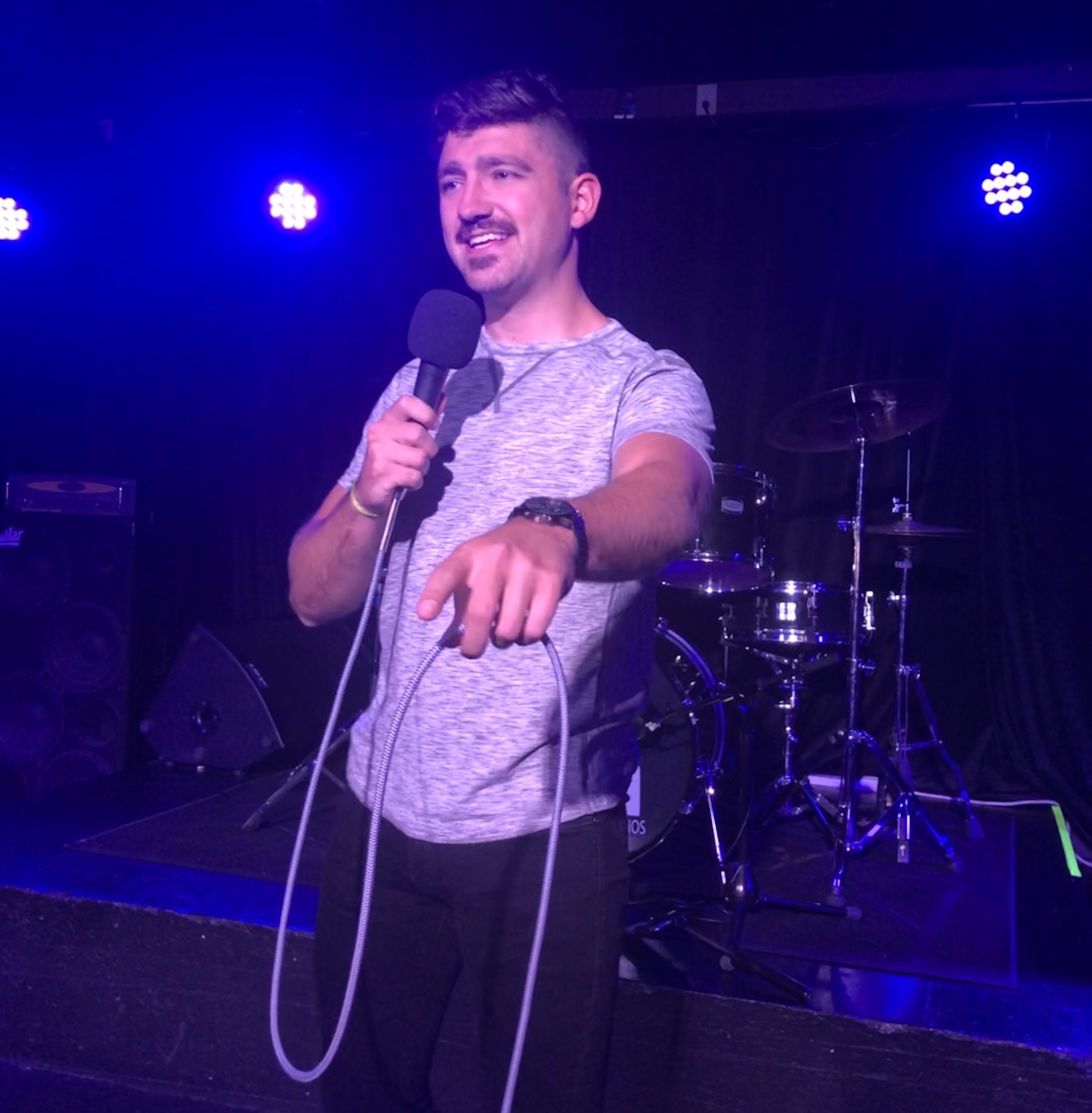
Who Is Wayne Veldsman?
Wayne Veldsman, owner of Vel.Consulting and Journey To Legacy, began his career by building several digital businesses out of his college dorm room....
Wayne is an accomplished business growth strategist, success coach, and entrepreneur. He specializes in helping entrepreneurial minded individuals to grow both their mindsets and their income.
After starting his first business in 2014, Wayne successfully launched and scaled a digital marketing agency to a 7-figure valuation before deciding to exit in 2019 to move to Denver, Colorado and start chasing his passion of coaching and public speaking.
Wayne actively works with entrepreneurs and businesses who are looking to take massive action and create drastic changes in their lives.
Not Sure How To Make The Drastic Change Necessary To Live The Life Of Freedom That Comes With Being A Lifestyle Entrepreneur?
Discover the stupid simple method to growing businesses digitally on autopilot, so that you can get back to your life.
Our students and clients aren't just satisfied, they're building life-changing businesses, doing what they want when they want, and living their lives chasing passion, not just profits.
Media Spotlights...





The 3-Step Strategy To Growing Businesses Digitally
Are you an Agency Owner, Service Provider, or Entrepreneur who sells online and want your pipeline filled with 300+ appointments with your idea client every single month? Are your SERIOUS about growing your business and want to work with Wayne 1-on-1?
Launch Into Digital Entrepreneurship is a course and coaching program specifically designed to take agency owners and online service providers from manual prospecting and wondering if this is ever going to work out, to having a very specific system in place which is going to allow you to generate 20 to 30 booked appointments every single day!
You're going to get a step by step process to building out your prospecting, sales and fulfilment system, and building your sales team so that you can close clients while stepping away from your sales process.
Price - $1,997 $97 (Limited Time Offer!)
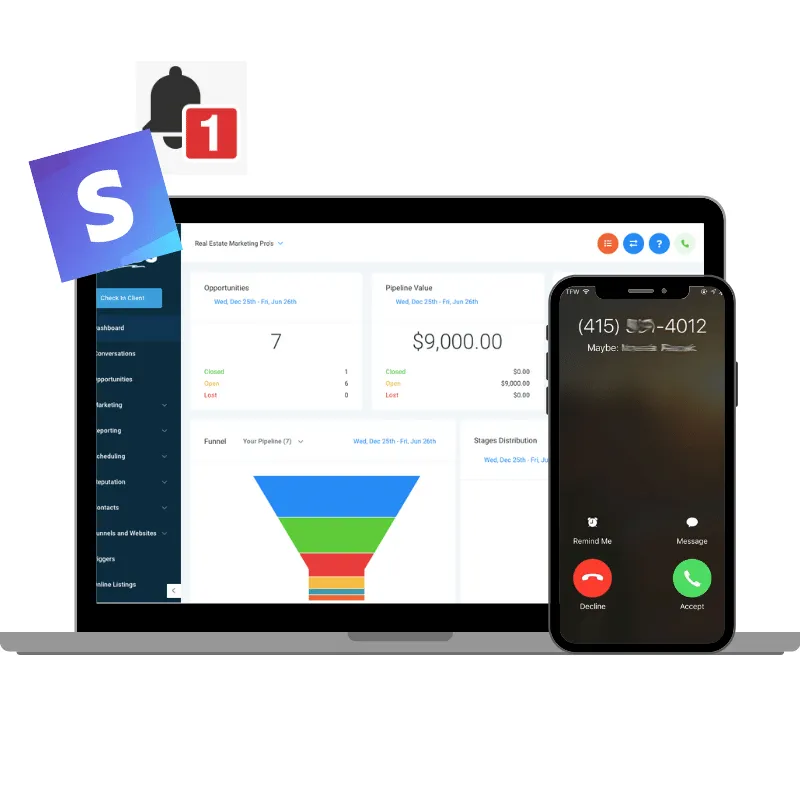
Every time we generate you a new lead interested in your marketing services, your dashboard will automatically add the new lead into your CRM, and send the new lead an SMS, email, and even automatically call you to connect you right away!

Become More Focused, Be More Productive, Burn Out Less
Price - FREE training
From The Desk Of Wayne Veldsman (blogs)
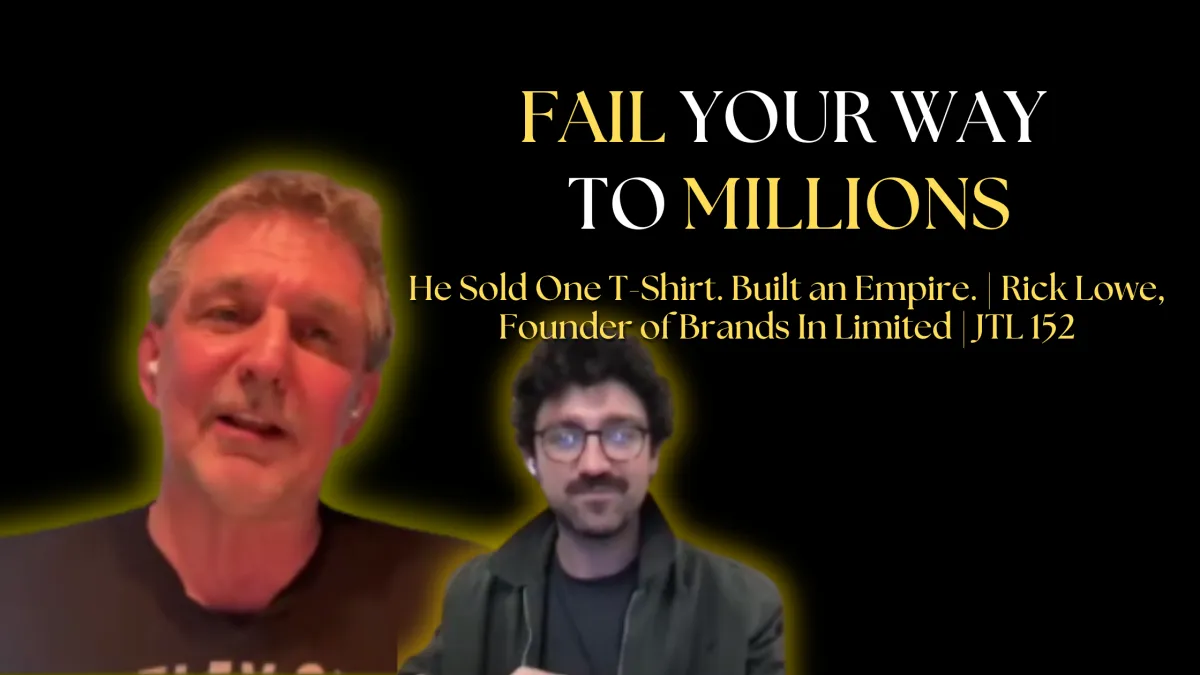
Why Staying in the Game Is the Only Strategy That Actually Works
Want to hear the full conversation? Listen to the Journey To Legacy podcast Episode 152 with Rick Lowe for even more insights and stories from his remarkable entrepreneurial journey.
Why Staying in the Game Is the Only Strategy That Actually Works
Most people don't fail because they made the wrong move.
They fail because they stopped moving.
There's a version of success that nobody talks about - not the big breakthrough, not the viral moment, not the overnight deal that changes everything. It's the version that's built slowly, quietly, and almost invisibly, by people who simply refused to quit when quitting made complete sense.
Rick Lowe is one of those people.
One Sale. Nine Hours. One Decision.
In 2003, Rick stood on Portobello Market in London on a cold, wet Saturday morning selling T-shirts. Nine hours later, he had made one sale. One. By most people's measure, that's a failure. Pack up, go home, try something else.
Rick saw it differently.
He thought: someone out there bought this. That means someone else will too. I just need to find more of them.
That single reframe - from "I failed" to "I have proof" - is the reason Rick Lowe now ships hundreds of thousands of units a year for Disney, Warner Brothers, The Rolling Stones, and some of the biggest entertainment brands in the world through his company Brands In.
Not because he was the smartest person in the room. Not because he had the best connections or the most capital. But because he stayed in the game long enough for one T-shirt to become ten, ten to become a hundred, and a hundred to become millions.
What Compounding Actually Looks Like in Business
This is what compounding actually looks like in business. Not spreadsheets and interest rates. Just consistent forward motion, over a long enough period of time, by someone who refused to let a bad day become a full stop.
The problem is most of us treat early results like final results. We launch something, it gets a lukewarm response, and we decide the market has spoken. We try something new, it doesn't land immediately, and we pivot before the thing ever had a chance to breathe.
But here's what Rick's story makes clear - the market hadn't spoken after one T-shirt. It had whispered. And he was paying attention.
If this idea of compounding consistency resonates with you, it's a thread that runs through almost every conversation on the [Journey to Legacy podcast - link to your podcast page]. The entrepreneurs who build something real are rarely the ones with the best idea. They're the ones who showed up long enough for the idea to work.
You Fail Your Way Forward
Rick said something in our conversation that I haven't been able to stop thinking about.
"You fail your way forward. Life is all about failure. Anyone who's ever achieved anything, no matter who they are, has failed so many more times. But they just stayed in the game - and that's sometimes all you need to do."
Most of us know this on some level. We've heard it before in different forms. But there's a difference between knowing it and actually living it on a cold Saturday when you've been standing in the rain for nine hours and you have one sale to show for it.
The difference is in how you frame what just happened.
Did you fail today? Or did you just find your first customer?
This reframe isn't just motivational fluff. It's a practical shift in how you measure progress. Something we talk about a lot on Journey to Legacy.
The Last Person Standing Wins
Rick also said the last person standing wins. Not the most talented. Not the best funded. The last one to give up.
Because if you reframe that one sale as a starting point rather than a verdict - you didn't have a bad day. You had proof of concept.
Rick Lowe's empire didn't begin with a big deal or a lucky break. It began with a decision to look at one sale and ask, how do I find the next one? You can follow everything he is building now over at ricklowe.co.uk and connect with him directly on LinkedIn.
That question, asked consistently, over enough time, is what compounds.
Stay in the game.
Transcript
WAYNE: It all started on a cold and wet Saturday morning market in the streets of London, where after nine hours, he had sold only one T-shirt. Most people would have packed up and gone home with their head down, but my guest today looked at that one sale and thought, "This is proof that the market exists. Now I just need to find more customers." That reframe is Rick Lowe's whole philosophy. From that rainy Saturday in 2003, he built a T-shirt apparel licensing business that now ships hundreds of thousands of units for Disney, Warner Brothers, The Rolling Stones and dozens of other household names and the biggest brands in the world. Before that, he was a boring engineer, a corporate job that paid well but meant nothing to him, and he also took a one-way trip to Miami with only three hundred dollars in his pocket that little did he know would change everything. My guest today is none other than Rick Lowe of Brands In Limited. He just turned sixty. His first book is nearly done, and in this conversation, he gave me something I won't forget. Lessons about failure, about self-motivation and about what legacy really looks like while you're still in the middle of building it. Enjoy.
Rick, I appreciate your time today. I'm honestly super excited to chat about so many of the things you have going on. Tell me, what is the main brand that you're focused on building these days?
RICK: So my main business is called Brands In Limited, and that's a licensing company where we take licenses from big entertainment people, or rights holders like Disney or Warner Brothers or Netflix, a lot of music artists or music companies that deal with their artists. We take those rights and then we make clothing, merchandise, fashion items and accessories with it. So the simplest thing is I'm wearing a Mötley Crüe T-shirt — we licensed that from the band through their management, merchandise managers, and then we'd go out and make T-shirts, sell them into retail. Could be the same with Disney, Mickey Mouse, could be the same with kids' pajamas, things like that.
WAYNE: Nice. Okay. And then Maverick Mindsets podcast — anything else specific that you wanna make sure that we talk about today? I know you had mentioned a book upcoming.
RICK: Yeah. So I've nearly completed my first book, always something I wanted to do, Wayne. It's called The Maverick Entrepreneur, and it's really about my journey and the lessons I've learned — all the times I've failed, basically.
WAYNE: You also mention that failure is your motivational tool.
RICK: It's good to talk to you, Wayne, 'cause I think people like us are on the same level where every day we're presented with a battle. And every day there's a challenge that we have to face, and it doesn't really get easier. There's always something that comes along and it's called life, and you've gotta deal with it.
WAYNE: Rick, before we get too deep — for people that aren't familiar with who you are, give us just a quick 60 seconds on your background and what you're working on these days.
RICK: Yeah, so I had a normal, let's say, education. Went off to university, did an engineering degree, which was hideously boring. And then I came over to America to seek my fortune for a couple of years, just generally odd jobbing and traveling around. Went back to the UK, got into a technical role with a company in the City of London, in the financial district, but didn't really enjoy it, Wayne. And long story short, someone gave me an opportunity to get into sales, corporate sales, and I worked my way up that business. But was never really fulfilled, wanted to do something on my own. And I got made redundant, which some people say is the end of the world, but I often think, as that Chinese proverb says, "As one door closes, another opens." Then I met a guy in a nightclub. He had an idea about selling Space Invaders T-shirts. I didn't have a clue about Space Invaders. I knew it was a video game, but never played it. Certainly didn't have a clue about making T-shirts. But we decided to set up a brand together, and we started selling on Portobello Market in Notting Hill in London, on a very cold November morning. And it went from there, really. With a suitcase going up and down high streets, knocking on doors, trying to sell T-shirts to fashion or streetwear stores. Then met another guy who had a big manufacturing set-up, and he said, "Let's throw in together. Go get some big licenses." So we got Warner Brothers, then we got Disney, got the music artists, and it kinda went from there. So it really did start from selling one T-shirt on a rainy Saturday morning on Portobello Market.
WAYNE: Wow. All the way until having these huge licenses. And so all the way up till today — you're primarily still running the same company? What are you working on today?
RICK: Yeah. So the main, my main day job, if you like, is Brands In, which takes those big licenses and makes product merchandise and fashion apparel with the logos. So if it's a Mickey Mouse or a Rolling Stones for music, et cetera. I also have an avid interest, I always have done Wayne, in personal development. So I enjoy public speaking. I've got a podcast I'm developing called Maverick Mindsets, which really talks to interesting people who've done something in life that I and my listeners can learn from. And then I'm writing my first book, it's nearly done, called The Maverick Entrepreneur. That was really a cathartic thing, Wayne. Something I wanted to set down on paper, see if I could do it. It's a personal journey through my life and all the lessons I've learned — what I can pass on to people and the things and the people that have inspired me. 'Cause you can't do anything on your own. You need other people around you.
WAYNE: How true it is. Rick, I'm excited for your first book. I know it's been years in the making. But let's rewind it all the way back. For people that aren't familiar with Journey to Legacy — we interview really impact-driven entrepreneurs that want to leave the world better than they found it. And I like to start back to where their interest in business came from, their interest in entrepreneurship. You said that you started in a household that was very traditional — a traditional path laid out for you. Thinking back, when did you realise that the traditional path wasn't the one for you? What did that look like?
RICK: Good question. I grew up in a fairly middle-of-the-road, nondescript town in the east of the UK. So I didn't grow up in London or some vibrant city. And I suppose it was looking around at what most people had, Wayne, and thinking, "I just want more. I wanna travel more. I wanna do more." I don't think I was a natural communicator or naturally assertive or overconfident. I think that comes with time when you learn your trade. My father was a schoolteacher, and so was my mum, actually. She taught handicapped kids. So I guess I always had knowledge around me, the ability to learn and read, which I still do today. I read a lot. So that was the foundation. But we weren't from a business background. My dad wasn't some super entrepreneur with a business he wanted to hand over to me. There was never any of that. So I had to go out and make my own way. And I think initially it was travel. I went off to America on my own or with a couple of mates to work on building sites and boats in Miami and all kinds of stuff, just to get away and do something different. And that was a big learning curve — leaving a small market town and going across the Atlantic with no job, no real money, no safety net. And then making my way from there. And I think I realized that if you are personable and you live by your word, and you do what you say you're gonna do, and you show up on time and put a shift in — people react positively and opportunities open. And if you have a mindset of "What's the worst thing that can happen?" — mostly someone's gonna say no, right? So the more no's you go through, the sooner you get to a yes. The idea in life is to get as many no's as you can. You fail your way forward, really. Life is all about failure. Anyone who's ever achieved anything has failed so many more times. But they just stayed in the game, and that's sometimes all you need to do.
WAYNE: I hear that almost the last man standing wins. The last one to give up, when you think about business, wins — because you're gonna keep getting knocked down, and as long as you keep getting up, that's pretty much all it takes. Rick, you said the shift when you traveled abroad to Miami had a huge impact. For some people out there, just that concept of going to a different country without a job laid out for you, without family or friends there, is already terrifying. What motivated you to try that, to get out of your comfort zone?
RICK: I didn't have any real plan. I remember it was November in the UK, Wayne, so the weather was awful. Rain and cold. And I always wanted to go to America because it seemed like the land of opportunity, and still is. Southern Florida was the only guaranteed hot place, so there was a direct flight on Virgin way back in the day when Richard Branson had just started out, and they gave you a return ticket — but as long as you used it within a year, you could move the date without any cost. A couple of mates I was working with in a summer job said they'd come with me. So the three of us went out there with really just a suitcase and a couple of hundred dollars — $300, if more. We started selling ice creams, then we got a job at a building site, then we met a guy who refurbished and looked after super yachts. Sounds very glamorous, but it was hard work. And we just found a way through it. Looking back, was it a massive risk? What's the worst thing that could have happened? I would've got on the plane and come back. Those formative experiences — a lot of what I learned in that year, year and a half, I still use today. A lot of the skills I learned when I first started my business and was selling T-shirts out of a suitcase, I still use every day. They're just more polished and you've got some more confidence around you. But no one gives you that — unless you're very lucky, and then if you're very lucky, you probably lose it 'cause you haven't got the skills to hang on to it.
WAYNE: Because you don't realise the value of it. Absolutely. And so through these formative experiences, through the businesses that you've run and the skills you've gained that you still use today — what would you say are a few of the top skills that people should be developing to make a success in their personal and professional life?
RICK: I think you've gotta have the ability to have what they call EQ, which basically means to be able to understand other humans and get on with them. And not necessarily agree with them, Wayne. We are all wonderfully unique. There's not another one of me, there's not another one of you out there, and we all think and learn and communicate in quite unique ways. What I learned when I was doing telesales and cold calling is you've got to develop rapport with people, which leads to trust. And I'm almost convinced most of my business now is based on trust. Trust over time and deep relationships become friendships. But the core thing for anybody is to learn how to work around and with other people. The danger the younger society I see have got is if they're glued to their phones where most of their social interactions come through a screen, they're never gonna learn how difficult but also engaging other people can be. So my advice is go work in a bar, go work in retail, something where you've got to talk to strangers and get some kind of quick relationship with them to influence and shape a situation. That's a core skill. If you can't communicate and develop rapport and trust, you probably won't get very far.
WAYNE: Communication, rapport, trust — absolutely vital. You mentioned EQ, which I think is the shorthand for emotional intelligence. I explain to a lot of individuals that my first job out of university, I was a cold calling salesperson. Not just cold calling on the phone — I was cold canvassing in person, going business to business, not knowing who was inside the door, trying to wheel and deal cellphone services. And I tell everyone it was the worst job I've ever had but the one I learned the very most in, and that I would recommend to everybody. Because the name of the game is building rapport and building trust quickly. Within five minutes I'm asking for their Social Security number, asking for IDs from this total stranger that walked into their business. So if you can learn how to build that rapport and trust quickly, it's a game changer, is what I'm hearing.
RICK: Yeah, yeah. And it's a core human skill. 'Cause your ability to influence or lead people is based on their ability to understand and connect with you. And if you've got ulterior motives or you don't want what's best for somebody, it's very easy for a human being to pick that up. Through centuries and thousands of years of evolution, the human psyche is able to decide if they trust somebody in a matter of seconds. So if you don't truly have what's best for them in mind, people pick up on it so quickly. I think everybody can have the confidence in themselves — if whatever you are motivated to sell, whether it's a service, a product or an idea, as long as you can vouch for yourself that you have the best intentions and you truly believe it will help the person you're speaking to, move forward with confidence.
WAYNE: Absolutely. And so Rick, after Miami, you chose to go back to the UK. What motivated that decision, and what was that like? I think you went back in 1991 when it wasn't a great time in the UK.
RICK: No, that's very true actually. Look, I'd been to university, Wayne. I'd got myself an academic qualification in electronics — electronic engineering. So the logic was I had to go and get a real job and have a real life and become a graduate trainee with some corporate business and try and climb the ladder to success. Which I did. And I worked for a very good company, actually. Very successful. But I wasn't very good as an engineer. It was very practical, very problem-solving — which is great in your day job as an entrepreneur, 'cause that's what you do. You solve problems every day. But this was more technical. And I remember sitting at my desk one day thinking, "I really wanna get into the commercial world." I saw a lot of people in sales — they had company cars and all these trappings, they earned more money — and I thought, "That's what I wanna do." But I had no experience. I applied for this job, and the recruitment guy said, "You're applying to sell technical test equipment. This was back in the day of the new broadband networks being used in the banking system. But you have no sales experience." And I said, "I've done this in my life, I've done that. I just need someone to give me an opportunity." And fortunately, the guy I went to interview for — who I'm still friends with today — gave me the first opportunity to really go out there and fail. What was interesting, Wayne, is he obviously saw something. He could have said, "Your target is $10 million a year." It made no odds to me. I had no frame of reference for what I was about to do. All I knew was I had to pick the phone up, smile and dial, and try and sell people stuff. And then that business went on to do well, and I did well with it. I got out on the road, started looking after big multinational accounts. But I was never fulfilled. I didn't want the CEO's job of a big company, flash car, smoking cigars on golf days. It was never what I wanted to do. And then in the first downturn of the dot-com bust in early 2000, I got the opportunity to be made redundant — got some money to fend for myself for six months — and that's when I thought, "Great." I struck out on my own. It was sink or swim. I saw it as an opportunity, not the fact that I'd lost my high-paid job.
WAYNE: Let's pause there for a second. You said you got the opportunity to be made redundant — which I wanna touch on. But also, Rick, you painted the picture just now of, for a lot of people, the dream. You were in a high-paying position, a company doing super well, smoking cigars on the golf course — yet you still weren't fulfilled. What were you feeling? Let's paint this picture so that people might understand, if they are feeling that right now, as a sign that they're meant for more, meant to make a pivot.
RICK: Yeah, I guess I had a burning desire to achieve something on my own, on my own terms. And I didn't have a magic formula or an opportunity to know what that was. A lot of the reading I've done — I'm sure you've done, we can all do — about visualisation and figuring out what you wanna do with your life. I've done a lot of work around the things I wanted to move towards — financial reward, material possessions, where I wanted to live, what kind of life I wanted, what was important to me. But again, I didn't have a vehicle to take me there. What happens in life is whatever you focus on grows, right? If you focus on bad things, you get bad things in your life. If you focus on what you want, you tend to move towards it, and this bizarre law of attraction I've never fully understood comes into play, and you attract the things towards you that may get you to where you wanna go. Not necessarily in one step — it could be two or three things. And that comes back to the whole piece on failure. You have to be open to learn and make mistakes. But if you have a vision in your mind of the kind of person and life you want, a vehicle will eventually come along. 'Cause here's the thing, Wayne — I am not my business. My business gives me things, not just financial reward but a lot of other things I really enjoy. But there is another business out there that could probably do the same. The business is a vehicle to building a life that I want, but also building the person I wanna become.
WAYNE: Absolutely. It truly is just that vehicle. But Rick, I just wanna reiterate what you said here around visualisation, manifestation, the law of attraction. What you focus on grows and attracts into your life. This is a tough concept for people to understand because it seems very wishy-washy or magical. But it sounds like it's a concept you genuinely believe in.
RICK: Yeah. I think it starts with trying to find and understand where success lives — whatever success is in your world, whatever you want. And then working yourself into environments where that success operates. Is it mixing with people that do things you wanna do? If you wanna be healthy, you generally mix with people who go to the gym or eat healthy. So I think for anybody thinking, "It's all right for Rick" or for Wayne — look at what they've done and achieved. You've just gotta have the antennae on your head working to move towards people that are doing what you wanna do. If you wanna be a doctor, you go and talk to doctors. You don't go and talk to a car mechanic. And they might say, "Do you know what? You're a nice person. Come and temp with me for a bit." You might do a really boring job with them, but you learn about it, and they might say, "There's an opportunity coming up, but it's in Massachusetts." You might not wanna do it, but it's an opportunity in the area you wanna move towards — and those are the things life throws up. But the common two things are: try and work out what it is you wanna do with your life, what's important to you. Don't just think about it in five minutes. Spend some time. They say it takes 24 hours of solid time to set your life goals. Coming back, reworking it, scratching it out in your notebook. And then once you've decided the kind of direction you wanna go in, it's about finding those pockets of people or orbits and getting into the orbit of people that are doing what you wanna do. That's the starting point.
WAYNE: That's the starting point — getting into the orbits of the people that are already doing what you wanna do or into the environments and areas. And Rick, I'm so happy you said that. In this idea of manifestation and visualisation, I do think there is a greater power that's difficult for us to explain. But the tangible piece of the puzzle is — if you wanna become a doctor, you go speak to doctors. Whatever you're focusing on, whatever you're visualising, it's now more top of mind. And now you are subconsciously looking for those opportunities, listening for them. You're taking these small micro-actions that will lead you to that path. And so a few years down the line when you think, "Wow, that visualisation thing is really magic," it's actually because you were opening yourself up to the opportunity. You were listening for it, looking for it without even realising it.
RICK: Yeah, yeah. I think the term I read years ago, Wayne, was sensory acuity. Your senses are tuned in to detecting what you've figured out in your mind you want to do. And it does work over time. It really does. And it's not about getting into some kind of zen mode where you've got a perfect life, humming to yourself sitting on a towel facing the sun. There's an element of being able to close all the noise down in your mind and really think about it. But, like everything, you've got to go through the motions of making an effort to really think about it.
WAYNE: Absolutely. Rick, take us through your first motions, your first efforts of launching into entrepreneurship on that rainy day on Portobello Market in 2003. How did you start? What did it feel like? I'm guessing you weren't sure if that was the correct path you were walking either.
RICK: No. No, no. Look, the fundamental of that first day, Wayne, was we managed to sell one T-shirt. Now, you might think — you've stood there for nine hours on a cold Saturday in London, Portobello Market is very busy and very trendy, a lot of tourists coming to London always go there, it's packed. Some might say, "You've only sold one T-shirt, so you've failed." But I thought, "I've sold one T-shirt. Now I need to find how I sell two and 10 and 100." And if I fast-forward to today, we're shipping thousands if not millions a year. It all starts with one step. It gave me the belief that there's someone out there who would buy one. All I had to do was go and find more people, and the better way was to talk to people who had stores so they could stock it, and then there'd be more people. But was it daunting? I think you just roll your sleeves up and enjoy the moment. That sounds very cliche, 'cause it was cold and wet — but it's a buzz. If you're doing something for yourself, you know you've not really got to answer to anybody apart from yourself. You've got the freedom to walk away at any point, and the power of knowing that actually keeps you in the game.
WAYNE: It's so true — the power of knowing you're the only one that's accountable, and you could leave at any time. You could give up, but then you actually choose to stay in the game. And what a great way to look at that success of selling a single shirt. "The market is there. Now I just need to find more people." And fast-forward to today, where you're shipping hundreds of thousands of shirts for some of the biggest brands in the entire world — starting with just selling that one T-shirt. Rick, something you talk about is that failure is your motivational tool. Where did that mindset come from? And maybe is there one or a couple of failures that distinctly sit with you, that maybe threatened everything you were doing, and how did they turn you around to where you are today?
RICK: Yeah. Life is full of failure. You don't get everything. And sometimes if you think it's what you want, you very quickly realize it isn't. The nature of running a business is challenging. You fail your way — but there are two things that will get you ahead that you absolutely need. One is some form of finance and management of finance, 'cause we do live in a capitalist society. And the other is people. And I've kind of failed in both areas. I've hired some people I thought were brilliant who were not great. Nothing personal, but they just didn't work out, weren't right for the business. I've also hired great people I wasn't 100% sure of who've gone on to be superstars. And then with the finance side, it's always a battle of cash flow — what's coming in, what's going out. As you grow a business, that's a whole different challenge. Starting a business is one thing. I've done a lot of talks to people who wanna start a business. The skills you need to start a business, there's a handful of them. To scale a business, you've then got to start looking at yourself. Are you the inhibitor? Are you the accelerator? What do you need to do to drive that business forward? I think in time I'll write another book on scaling a business, 'cause I think you have to go through another development cycle yourself to really scale. So failure's always around you. People and finance are two key areas that hover about all the time that you've gotta keep on top of.
WAYNE: Absolutely. Rick, a question I'm just seeing in my notes — I think it's a good thing to touch on before we start to wrap up. People don't know where to start, what they should be doing, what businesses to chase. So essentially the question is: how do you see, create and grab opportunity? How do you seize it? How do you know which opportunities to grab?
RICK: Wayne, if you spend the time to understand what's important to you — if someone says, "I wanna go and start a business but I don't know what to do" — what is it you enjoy doing? Do you enjoy people? If you didn't, then maybe you're not gonna be great at certain aspects of a business. Maybe you wanna become a techie or a coder where you don't have to talk to people as much. There are businesses there. Do you wanna live in a city? Do you love the countryside? What kind of environment ticks the boxes to give you the life you want? 'Cause again, the business is a vehicle. And what inspires you? Is it medicine? Is it creating art? Is it building houses? What are the elements that you're drawn towards that motivate you? That, to me, is the starting point. When I came out of corporate life, Wayne, I knew what I enjoyed about it and what I didn't enjoy about it. I enjoyed the travel. I enjoyed the commercial selling, the building. I didn't enjoy detail and I didn't enjoy admin. So when I looked at business opportunities — going back to how I got started selling T-shirts — I knew it was more creative. It was to do with fashion and brands. It would involve travel if I was able to develop it. I was able to work with women as well, because I'd only really worked with men in a very techy, male-dominated environment, and there's 50% of the world's population I wasn't working with. So I wanted to extend in all those areas. And the underlying thing for me was I wanted to continue to learn and grow. I didn't really want to be pigeonholed. The skills we learn in life — certainly in business as well — are very transportable. You can take those learnings and drop them into another endeavour and still be successful. There are loads of sports stars who've been very successful in business, because many of the disciplines you have in sport getting to the top are exactly the same as in business. So those are the things that I think are kind of turning points in my mind.
WAYNE: Absolutely. The way to see and seize opportunity is to first get clear on what you want, so you can understand the direction you want to go. As you stated, you wanted an opportunity for travel, to work with exciting brands, to work with women at the time when you'd come from an engineering industry that was male-driven — and then the vehicle and the opportunity that presented itself was through selling T-shirts. And you were only able to seize that opportunity because you had become clear on more of the things that you wanted.
RICK: Yeah, I think so. And also the challenge we all face as humans, Wayne, is we look at other people and compare ourselves — probably more now with what's going on on social media. It's very hard for the younger generations, 'cause everyone's got this perfect life. And the reality is they don't. No one has a perfect life, no matter who you are. And I would always advise anybody to try and have the courage to be yourself and work out what's important to you. Looking at what other people have and their lifestyle may not be what you actually want. And if you have the courage and inner drive to really go after what you want — within reason, you've gotta learn, you've gotta make mistakes, you've gotta develop and change — but that's life. For those out there thinking, "Well, great, I still can't quite decide what I wanna be, but all these other people have this wonderful life" — spend the time to focus on yourself. The only person you really compete with in life is yourself. Don't compete with anybody else.
WAYNE: So, so true. I love how you just said that — have the courage to be yourself. Rick, I'm curious, just for fun, thinking back on different stories — you've worked with huge brands. Is there a partnership or a brand that you've gotten to work with that was particularly exciting for you? And how did that develop?
RICK: I think they're all exciting in different ways. Because of the nature of what they do, they're entertainment brands. They have a set of consumers who are fanatical about what they do, whether it be music or movies. For me, because I've got a passion in rock music, it's great to look at some of the old artwork that these aging rock bands have developed. And they're still relevant, still out there, many of them on tour, still reaching consumers. They've not decided to pack up, and they've still got a thirst to create and develop. And then Disney will come out with another movie that'll be brilliant in ways they've not done before, but the core foundation of Disney is Mickey Mouse. It's iconic. So when you're dealing with icons, there's a lot to learn. What makes them an icon — that ability to reinvent and still relate and communicate to the same fan base, but also find a new fan base, find new consumers.
WAYNE: Wonderful. Rick, I appreciate your time today so greatly. And with the theme of the show being around legacy, I always like to ask this question. You have such a diverse and exciting career — in finance, huge business, but of course you also talk a lot about personal development and passion and speaking. So when it comes to the theme of legacy, what does legacy even mean to you? And is there a legacy that you're working to leave on this world?
RICK: I think the legacy is that people will not remember what you say. They will remember some of what you do. But they will definitely remember how you made them feel. All the biggest impacts we've all had as human beings have been an emotional connection of one way or another — and it's about feeling. So in terms of legacy, I've got two little kids now, Wayne, and obviously you've got closer legacy, which is your family, your nearest and dearest. I'm very conscious of how they're learning and developing as little mini human beings. But fundamentally, you just wanna be an honourable person. You wanna go to your grave thinking, "Do you know what? I was given this set of tools or cards, and I've made it better. Along the way, I've helped people, and hopefully people have learned from what I've done and they can take it forward." That's all we can really hope for. Most of us are one in seven billion people. We're all functioning dysfunctionals. Not one of us are truly functional. We're human beings, not robots. We are emotional. And I think you've gotta do the best with what you've got and try to improve yourself, and along the way give back to other people. That's where your biggest payback is — what you do for other people. When you go to your grave, it's not "I wish I'd spent more time in the office" or "I wish I had another £100 in my bank account." It's the experiences you've had with other humans in a good way.
WAYNE: It's true. Whatever way it might come across — it truly is be the best version of yourself. Rick, you said it earlier — have the courage to be yourself, and along the way, help everybody else around you.
RICK: Exactly.
WAYNE: Beautiful. Rick, my friend, greatly appreciate your time. It's been an absolute pleasure.
RICK: Pleasure. Thank you very much, Wayne. Really enjoyed it.
The 3-Step Strategy To Growing Businesses Digitally
Are you an Agency Owner, Service Provider, or Entrepreneur who sells online and want your pipeline filled with 300+ appointments with your idea client every single month? Are your SERIOUS about growing your business and want to work with Wayne 1-on-1?
Launch Into Digital Entrepreneurship is a course and coaching program specifically designed to take agency owners and online service providers from manual prospecting and wondering if this is ever going to work out, to having a very specific system in place which is going to allow you to generate 20 to 30 booked appointments every single day!
You're going to get a step by step process to building out your prospecting, sales and fulfilment system, and building your sales team so that you can close clients while stepping away from your sales process.
Price - $1,997 $97 (Limited Time Offer!)
Every time we generate you a new lead interested in your marketing services, your dashboard will automatically add the new lead into your CRM, and send the new lead an SMS, email, and even automatically call you to connect you right away!
Become More Focused, Be More Productive, Burn Out Less
Price - FREE Training
From The Desk Of Wayne Veldsman (blogs)
Why Staying in the Game Is the Only Strategy That Actually Works
Want to hear the full conversation? Listen to the Journey To Legacy podcast Episode 152 with Rick Lowe for even more insights and stories from his remarkable entrepreneurial journey.
Why Staying in the Game Is the Only Strategy That Actually Works
Most people don't fail because they made the wrong move.
They fail because they stopped moving.
There's a version of success that nobody talks about - not the big breakthrough, not the viral moment, not the overnight deal that changes everything. It's the version that's built slowly, quietly, and almost invisibly, by people who simply refused to quit when quitting made complete sense.
Rick Lowe is one of those people.
One Sale. Nine Hours. One Decision.
In 2003, Rick stood on Portobello Market in London on a cold, wet Saturday morning selling T-shirts. Nine hours later, he had made one sale. One. By most people's measure, that's a failure. Pack up, go home, try something else.
Rick saw it differently.
He thought: someone out there bought this. That means someone else will too. I just need to find more of them.
That single reframe - from "I failed" to "I have proof" - is the reason Rick Lowe now ships hundreds of thousands of units a year for Disney, Warner Brothers, The Rolling Stones, and some of the biggest entertainment brands in the world through his company Brands In.
Not because he was the smartest person in the room. Not because he had the best connections or the most capital. But because he stayed in the game long enough for one T-shirt to become ten, ten to become a hundred, and a hundred to become millions.
What Compounding Actually Looks Like in Business
This is what compounding actually looks like in business. Not spreadsheets and interest rates. Just consistent forward motion, over a long enough period of time, by someone who refused to let a bad day become a full stop.
The problem is most of us treat early results like final results. We launch something, it gets a lukewarm response, and we decide the market has spoken. We try something new, it doesn't land immediately, and we pivot before the thing ever had a chance to breathe.
But here's what Rick's story makes clear - the market hadn't spoken after one T-shirt. It had whispered. And he was paying attention.
If this idea of compounding consistency resonates with you, it's a thread that runs through almost every conversation on the [Journey to Legacy podcast - link to your podcast page]. The entrepreneurs who build something real are rarely the ones with the best idea. They're the ones who showed up long enough for the idea to work.
You Fail Your Way Forward
Rick said something in our conversation that I haven't been able to stop thinking about.
"You fail your way forward. Life is all about failure. Anyone who's ever achieved anything, no matter who they are, has failed so many more times. But they just stayed in the game - and that's sometimes all you need to do."
Most of us know this on some level. We've heard it before in different forms. But there's a difference between knowing it and actually living it on a cold Saturday when you've been standing in the rain for nine hours and you have one sale to show for it.
The difference is in how you frame what just happened.
Did you fail today? Or did you just find your first customer?
This reframe isn't just motivational fluff. It's a practical shift in how you measure progress. Something we talk about a lot on Journey to Legacy.
The Last Person Standing Wins
Rick also said the last person standing wins. Not the most talented. Not the best funded. The last one to give up.
Because if you reframe that one sale as a starting point rather than a verdict - you didn't have a bad day. You had proof of concept.
Rick Lowe's empire didn't begin with a big deal or a lucky break. It began with a decision to look at one sale and ask, how do I find the next one? You can follow everything he is building now over at ricklowe.co.uk and connect with him directly on LinkedIn.
That question, asked consistently, over enough time, is what compounds.
Stay in the game.
Transcript
WAYNE: It all started on a cold and wet Saturday morning market in the streets of London, where after nine hours, he had sold only one T-shirt. Most people would have packed up and gone home with their head down, but my guest today looked at that one sale and thought, "This is proof that the market exists. Now I just need to find more customers." That reframe is Rick Lowe's whole philosophy. From that rainy Saturday in 2003, he built a T-shirt apparel licensing business that now ships hundreds of thousands of units for Disney, Warner Brothers, The Rolling Stones and dozens of other household names and the biggest brands in the world. Before that, he was a boring engineer, a corporate job that paid well but meant nothing to him, and he also took a one-way trip to Miami with only three hundred dollars in his pocket that little did he know would change everything. My guest today is none other than Rick Lowe of Brands In Limited. He just turned sixty. His first book is nearly done, and in this conversation, he gave me something I won't forget. Lessons about failure, about self-motivation and about what legacy really looks like while you're still in the middle of building it. Enjoy.
Rick, I appreciate your time today. I'm honestly super excited to chat about so many of the things you have going on. Tell me, what is the main brand that you're focused on building these days?
RICK: So my main business is called Brands In Limited, and that's a licensing company where we take licenses from big entertainment people, or rights holders like Disney or Warner Brothers or Netflix, a lot of music artists or music companies that deal with their artists. We take those rights and then we make clothing, merchandise, fashion items and accessories with it. So the simplest thing is I'm wearing a Mötley Crüe T-shirt — we licensed that from the band through their management, merchandise managers, and then we'd go out and make T-shirts, sell them into retail. Could be the same with Disney, Mickey Mouse, could be the same with kids' pajamas, things like that.
WAYNE: Nice. Okay. And then Maverick Mindsets podcast — anything else specific that you wanna make sure that we talk about today? I know you had mentioned a book upcoming.
RICK: Yeah. So I've nearly completed my first book, always something I wanted to do, Wayne. It's called The Maverick Entrepreneur, and it's really about my journey and the lessons I've learned — all the times I've failed, basically.
WAYNE: You also mention that failure is your motivational tool.
RICK: It's good to talk to you, Wayne, 'cause I think people like us are on the same level where every day we're presented with a battle. And every day there's a challenge that we have to face, and it doesn't really get easier. There's always something that comes along and it's called life, and you've gotta deal with it.
WAYNE: Rick, before we get too deep — for people that aren't familiar with who you are, give us just a quick 60 seconds on your background and what you're working on these days.
RICK: Yeah, so I had a normal, let's say, education. Went off to university, did an engineering degree, which was hideously boring. And then I came over to America to seek my fortune for a couple of years, just generally odd jobbing and traveling around. Went back to the UK, got into a technical role with a company in the City of London, in the financial district, but didn't really enjoy it, Wayne. And long story short, someone gave me an opportunity to get into sales, corporate sales, and I worked my way up that business. But was never really fulfilled, wanted to do something on my own. And I got made redundant, which some people say is the end of the world, but I often think, as that Chinese proverb says, "As one door closes, another opens." Then I met a guy in a nightclub. He had an idea about selling Space Invaders T-shirts. I didn't have a clue about Space Invaders. I knew it was a video game, but never played it. Certainly didn't have a clue about making T-shirts. But we decided to set up a brand together, and we started selling on Portobello Market in Notting Hill in London, on a very cold November morning. And it went from there, really. With a suitcase going up and down high streets, knocking on doors, trying to sell T-shirts to fashion or streetwear stores. Then met another guy who had a big manufacturing set-up, and he said, "Let's throw in together. Go get some big licenses." So we got Warner Brothers, then we got Disney, got the music artists, and it kinda went from there. So it really did start from selling one T-shirt on a rainy Saturday morning on Portobello Market.
WAYNE: Wow. All the way until having these huge licenses. And so all the way up till today — you're primarily still running the same company? What are you working on today?
RICK: Yeah. So the main, my main day job, if you like, is Brands In, which takes those big licenses and makes product merchandise and fashion apparel with the logos. So if it's a Mickey Mouse or a Rolling Stones for music, et cetera. I also have an avid interest, I always have done Wayne, in personal development. So I enjoy public speaking. I've got a podcast I'm developing called Maverick Mindsets, which really talks to interesting people who've done something in life that I and my listeners can learn from. And then I'm writing my first book, it's nearly done, called The Maverick Entrepreneur. That was really a cathartic thing, Wayne. Something I wanted to set down on paper, see if I could do it. It's a personal journey through my life and all the lessons I've learned — what I can pass on to people and the things and the people that have inspired me. 'Cause you can't do anything on your own. You need other people around you.
WAYNE: How true it is. Rick, I'm excited for your first book. I know it's been years in the making. But let's rewind it all the way back. For people that aren't familiar with Journey to Legacy — we interview really impact-driven entrepreneurs that want to leave the world better than they found it. And I like to start back to where their interest in business came from, their interest in entrepreneurship. You said that you started in a household that was very traditional — a traditional path laid out for you. Thinking back, when did you realise that the traditional path wasn't the one for you? What did that look like?
RICK: Good question. I grew up in a fairly middle-of-the-road, nondescript town in the east of the UK. So I didn't grow up in London or some vibrant city. And I suppose it was looking around at what most people had, Wayne, and thinking, "I just want more. I wanna travel more. I wanna do more." I don't think I was a natural communicator or naturally assertive or overconfident. I think that comes with time when you learn your trade. My father was a schoolteacher, and so was my mum, actually. She taught handicapped kids. So I guess I always had knowledge around me, the ability to learn and read, which I still do today. I read a lot. So that was the foundation. But we weren't from a business background. My dad wasn't some super entrepreneur with a business he wanted to hand over to me. There was never any of that. So I had to go out and make my own way. And I think initially it was travel. I went off to America on my own or with a couple of mates to work on building sites and boats in Miami and all kinds of stuff, just to get away and do something different. And that was a big learning curve — leaving a small market town and going across the Atlantic with no job, no real money, no safety net. And then making my way from there. And I think I realized that if you are personable and you live by your word, and you do what you say you're gonna do, and you show up on time and put a shift in — people react positively and opportunities open. And if you have a mindset of "What's the worst thing that can happen?" — mostly someone's gonna say no, right? So the more no's you go through, the sooner you get to a yes. The idea in life is to get as many no's as you can. You fail your way forward, really. Life is all about failure. Anyone who's ever achieved anything has failed so many more times. But they just stayed in the game, and that's sometimes all you need to do.
WAYNE: I hear that almost the last man standing wins. The last one to give up, when you think about business, wins — because you're gonna keep getting knocked down, and as long as you keep getting up, that's pretty much all it takes. Rick, you said the shift when you traveled abroad to Miami had a huge impact. For some people out there, just that concept of going to a different country without a job laid out for you, without family or friends there, is already terrifying. What motivated you to try that, to get out of your comfort zone?
RICK: I didn't have any real plan. I remember it was November in the UK, Wayne, so the weather was awful. Rain and cold. And I always wanted to go to America because it seemed like the land of opportunity, and still is. Southern Florida was the only guaranteed hot place, so there was a direct flight on Virgin way back in the day when Richard Branson had just started out, and they gave you a return ticket — but as long as you used it within a year, you could move the date without any cost. A couple of mates I was working with in a summer job said they'd come with me. So the three of us went out there with really just a suitcase and a couple of hundred dollars — $300, if more. We started selling ice creams, then we got a job at a building site, then we met a guy who refurbished and looked after super yachts. Sounds very glamorous, but it was hard work. And we just found a way through it. Looking back, was it a massive risk? What's the worst thing that could have happened? I would've got on the plane and come back. Those formative experiences — a lot of what I learned in that year, year and a half, I still use today. A lot of the skills I learned when I first started my business and was selling T-shirts out of a suitcase, I still use every day. They're just more polished and you've got some more confidence around you. But no one gives you that — unless you're very lucky, and then if you're very lucky, you probably lose it 'cause you haven't got the skills to hang on to it.
WAYNE: Because you don't realise the value of it. Absolutely. And so through these formative experiences, through the businesses that you've run and the skills you've gained that you still use today — what would you say are a few of the top skills that people should be developing to make a success in their personal and professional life?
RICK: I think you've gotta have the ability to have what they call EQ, which basically means to be able to understand other humans and get on with them. And not necessarily agree with them, Wayne. We are all wonderfully unique. There's not another one of me, there's not another one of you out there, and we all think and learn and communicate in quite unique ways. What I learned when I was doing telesales and cold calling is you've got to develop rapport with people, which leads to trust. And I'm almost convinced most of my business now is based on trust. Trust over time and deep relationships become friendships. But the core thing for anybody is to learn how to work around and with other people. The danger the younger society I see have got is if they're glued to their phones where most of their social interactions come through a screen, they're never gonna learn how difficult but also engaging other people can be. So my advice is go work in a bar, go work in retail, something where you've got to talk to strangers and get some kind of quick relationship with them to influence and shape a situation. That's a core skill. If you can't communicate and develop rapport and trust, you probably won't get very far.
WAYNE: Communication, rapport, trust — absolutely vital. You mentioned EQ, which I think is the shorthand for emotional intelligence. I explain to a lot of individuals that my first job out of university, I was a cold calling salesperson. Not just cold calling on the phone — I was cold canvassing in person, going business to business, not knowing who was inside the door, trying to wheel and deal cellphone services. And I tell everyone it was the worst job I've ever had but the one I learned the very most in, and that I would recommend to everybody. Because the name of the game is building rapport and building trust quickly. Within five minutes I'm asking for their Social Security number, asking for IDs from this total stranger that walked into their business. So if you can learn how to build that rapport and trust quickly, it's a game changer, is what I'm hearing.
RICK: Yeah, yeah. And it's a core human skill. 'Cause your ability to influence or lead people is based on their ability to understand and connect with you. And if you've got ulterior motives or you don't want what's best for somebody, it's very easy for a human being to pick that up. Through centuries and thousands of years of evolution, the human psyche is able to decide if they trust somebody in a matter of seconds. So if you don't truly have what's best for them in mind, people pick up on it so quickly. I think everybody can have the confidence in themselves — if whatever you are motivated to sell, whether it's a service, a product or an idea, as long as you can vouch for yourself that you have the best intentions and you truly believe it will help the person you're speaking to, move forward with confidence.
WAYNE: Absolutely. And so Rick, after Miami, you chose to go back to the UK. What motivated that decision, and what was that like? I think you went back in 1991 when it wasn't a great time in the UK.
RICK: No, that's very true actually. Look, I'd been to university, Wayne. I'd got myself an academic qualification in electronics — electronic engineering. So the logic was I had to go and get a real job and have a real life and become a graduate trainee with some corporate business and try and climb the ladder to success. Which I did. And I worked for a very good company, actually. Very successful. But I wasn't very good as an engineer. It was very practical, very problem-solving — which is great in your day job as an entrepreneur, 'cause that's what you do. You solve problems every day. But this was more technical. And I remember sitting at my desk one day thinking, "I really wanna get into the commercial world." I saw a lot of people in sales — they had company cars and all these trappings, they earned more money — and I thought, "That's what I wanna do." But I had no experience. I applied for this job, and the recruitment guy said, "You're applying to sell technical test equipment. This was back in the day of the new broadband networks being used in the banking system. But you have no sales experience." And I said, "I've done this in my life, I've done that. I just need someone to give me an opportunity." And fortunately, the guy I went to interview for — who I'm still friends with today — gave me the first opportunity to really go out there and fail. What was interesting, Wayne, is he obviously saw something. He could have said, "Your target is $10 million a year." It made no odds to me. I had no frame of reference for what I was about to do. All I knew was I had to pick the phone up, smile and dial, and try and sell people stuff. And then that business went on to do well, and I did well with it. I got out on the road, started looking after big multinational accounts. But I was never fulfilled. I didn't want the CEO's job of a big company, flash car, smoking cigars on golf days. It was never what I wanted to do. And then in the first downturn of the dot-com bust in early 2000, I got the opportunity to be made redundant — got some money to fend for myself for six months — and that's when I thought, "Great." I struck out on my own. It was sink or swim. I saw it as an opportunity, not the fact that I'd lost my high-paid job.
WAYNE: Let's pause there for a second. You said you got the opportunity to be made redundant — which I wanna touch on. But also, Rick, you painted the picture just now of, for a lot of people, the dream. You were in a high-paying position, a company doing super well, smoking cigars on the golf course — yet you still weren't fulfilled. What were you feeling? Let's paint this picture so that people might understand, if they are feeling that right now, as a sign that they're meant for more, meant to make a pivot.
RICK: Yeah, I guess I had a burning desire to achieve something on my own, on my own terms. And I didn't have a magic formula or an opportunity to know what that was. A lot of the reading I've done — I'm sure you've done, we can all do — about visualisation and figuring out what you wanna do with your life. I've done a lot of work around the things I wanted to move towards — financial reward, material possessions, where I wanted to live, what kind of life I wanted, what was important to me. But again, I didn't have a vehicle to take me there. What happens in life is whatever you focus on grows, right? If you focus on bad things, you get bad things in your life. If you focus on what you want, you tend to move towards it, and this bizarre law of attraction I've never fully understood comes into play, and you attract the things towards you that may get you to where you wanna go. Not necessarily in one step — it could be two or three things. And that comes back to the whole piece on failure. You have to be open to learn and make mistakes. But if you have a vision in your mind of the kind of person and life you want, a vehicle will eventually come along. 'Cause here's the thing, Wayne — I am not my business. My business gives me things, not just financial reward but a lot of other things I really enjoy. But there is another business out there that could probably do the same. The business is a vehicle to building a life that I want, but also building the person I wanna become.
WAYNE: Absolutely. It truly is just that vehicle. But Rick, I just wanna reiterate what you said here around visualisation, manifestation, the law of attraction. What you focus on grows and attracts into your life. This is a tough concept for people to understand because it seems very wishy-washy or magical. But it sounds like it's a concept you genuinely believe in.
RICK: Yeah. I think it starts with trying to find and understand where success lives — whatever success is in your world, whatever you want. And then working yourself into environments where that success operates. Is it mixing with people that do things you wanna do? If you wanna be healthy, you generally mix with people who go to the gym or eat healthy. So I think for anybody thinking, "It's all right for Rick" or for Wayne — look at what they've done and achieved. You've just gotta have the antennae on your head working to move towards people that are doing what you wanna do. If you wanna be a doctor, you go and talk to doctors. You don't go and talk to a car mechanic. And they might say, "Do you know what? You're a nice person. Come and temp with me for a bit." You might do a really boring job with them, but you learn about it, and they might say, "There's an opportunity coming up, but it's in Massachusetts." You might not wanna do it, but it's an opportunity in the area you wanna move towards — and those are the things life throws up. But the common two things are: try and work out what it is you wanna do with your life, what's important to you. Don't just think about it in five minutes. Spend some time. They say it takes 24 hours of solid time to set your life goals. Coming back, reworking it, scratching it out in your notebook. And then once you've decided the kind of direction you wanna go in, it's about finding those pockets of people or orbits and getting into the orbit of people that are doing what you wanna do. That's the starting point.
WAYNE: That's the starting point — getting into the orbits of the people that are already doing what you wanna do or into the environments and areas. And Rick, I'm so happy you said that. In this idea of manifestation and visualisation, I do think there is a greater power that's difficult for us to explain. But the tangible piece of the puzzle is — if you wanna become a doctor, you go speak to doctors. Whatever you're focusing on, whatever you're visualising, it's now more top of mind. And now you are subconsciously looking for those opportunities, listening for them. You're taking these small micro-actions that will lead you to that path. And so a few years down the line when you think, "Wow, that visualisation thing is really magic," it's actually because you were opening yourself up to the opportunity. You were listening for it, looking for it without even realising it.
RICK: Yeah, yeah. I think the term I read years ago, Wayne, was sensory acuity. Your senses are tuned in to detecting what you've figured out in your mind you want to do. And it does work over time. It really does. And it's not about getting into some kind of zen mode where you've got a perfect life, humming to yourself sitting on a towel facing the sun. There's an element of being able to close all the noise down in your mind and really think about it. But, like everything, you've got to go through the motions of making an effort to really think about it.
WAYNE: Absolutely. Rick, take us through your first motions, your first efforts of launching into entrepreneurship on that rainy day on Portobello Market in 2003. How did you start? What did it feel like? I'm guessing you weren't sure if that was the correct path you were walking either.
RICK: No. No, no. Look, the fundamental of that first day, Wayne, was we managed to sell one T-shirt. Now, you might think — you've stood there for nine hours on a cold Saturday in London, Portobello Market is very busy and very trendy, a lot of tourists coming to London always go there, it's packed. Some might say, "You've only sold one T-shirt, so you've failed." But I thought, "I've sold one T-shirt. Now I need to find how I sell two and 10 and 100." And if I fast-forward to today, we're shipping thousands if not millions a year. It all starts with one step. It gave me the belief that there's someone out there who would buy one. All I had to do was go and find more people, and the better way was to talk to people who had stores so they could stock it, and then there'd be more people. But was it daunting? I think you just roll your sleeves up and enjoy the moment. That sounds very cliche, 'cause it was cold and wet — but it's a buzz. If you're doing something for yourself, you know you've not really got to answer to anybody apart from yourself. You've got the freedom to walk away at any point, and the power of knowing that actually keeps you in the game.
WAYNE: It's so true — the power of knowing you're the only one that's accountable, and you could leave at any time. You could give up, but then you actually choose to stay in the game. And what a great way to look at that success of selling a single shirt. "The market is there. Now I just need to find more people." And fast-forward to today, where you're shipping hundreds of thousands of shirts for some of the biggest brands in the entire world — starting with just selling that one T-shirt. Rick, something you talk about is that failure is your motivational tool. Where did that mindset come from? And maybe is there one or a couple of failures that distinctly sit with you, that maybe threatened everything you were doing, and how did they turn you around to where you are today?
RICK: Yeah. Life is full of failure. You don't get everything. And sometimes if you think it's what you want, you very quickly realize it isn't. The nature of running a business is challenging. You fail your way — but there are two things that will get you ahead that you absolutely need. One is some form of finance and management of finance, 'cause we do live in a capitalist society. And the other is people. And I've kind of failed in both areas. I've hired some people I thought were brilliant who were not great. Nothing personal, but they just didn't work out, weren't right for the business. I've also hired great people I wasn't 100% sure of who've gone on to be superstars. And then with the finance side, it's always a battle of cash flow — what's coming in, what's going out. As you grow a business, that's a whole different challenge. Starting a business is one thing. I've done a lot of talks to people who wanna start a business. The skills you need to start a business, there's a handful of them. To scale a business, you've then got to start looking at yourself. Are you the inhibitor? Are you the accelerator? What do you need to do to drive that business forward? I think in time I'll write another book on scaling a business, 'cause I think you have to go through another development cycle yourself to really scale. So failure's always around you. People and finance are two key areas that hover about all the time that you've gotta keep on top of.
WAYNE: Absolutely. Rick, a question I'm just seeing in my notes — I think it's a good thing to touch on before we start to wrap up. People don't know where to start, what they should be doing, what businesses to chase. So essentially the question is: how do you see, create and grab opportunity? How do you seize it? How do you know which opportunities to grab?
RICK: Wayne, if you spend the time to understand what's important to you — if someone says, "I wanna go and start a business but I don't know what to do" — what is it you enjoy doing? Do you enjoy people? If you didn't, then maybe you're not gonna be great at certain aspects of a business. Maybe you wanna become a techie or a coder where you don't have to talk to people as much. There are businesses there. Do you wanna live in a city? Do you love the countryside? What kind of environment ticks the boxes to give you the life you want? 'Cause again, the business is a vehicle. And what inspires you? Is it medicine? Is it creating art? Is it building houses? What are the elements that you're drawn towards that motivate you? That, to me, is the starting point. When I came out of corporate life, Wayne, I knew what I enjoyed about it and what I didn't enjoy about it. I enjoyed the travel. I enjoyed the commercial selling, the building. I didn't enjoy detail and I didn't enjoy admin. So when I looked at business opportunities — going back to how I got started selling T-shirts — I knew it was more creative. It was to do with fashion and brands. It would involve travel if I was able to develop it. I was able to work with women as well, because I'd only really worked with men in a very techy, male-dominated environment, and there's 50% of the world's population I wasn't working with. So I wanted to extend in all those areas. And the underlying thing for me was I wanted to continue to learn and grow. I didn't really want to be pigeonholed. The skills we learn in life — certainly in business as well — are very transportable. You can take those learnings and drop them into another endeavour and still be successful. There are loads of sports stars who've been very successful in business, because many of the disciplines you have in sport getting to the top are exactly the same as in business. So those are the things that I think are kind of turning points in my mind.
WAYNE: Absolutely. The way to see and seize opportunity is to first get clear on what you want, so you can understand the direction you want to go. As you stated, you wanted an opportunity for travel, to work with exciting brands, to work with women at the time when you'd come from an engineering industry that was male-driven — and then the vehicle and the opportunity that presented itself was through selling T-shirts. And you were only able to seize that opportunity because you had become clear on more of the things that you wanted.
RICK: Yeah, I think so. And also the challenge we all face as humans, Wayne, is we look at other people and compare ourselves — probably more now with what's going on on social media. It's very hard for the younger generations, 'cause everyone's got this perfect life. And the reality is they don't. No one has a perfect life, no matter who you are. And I would always advise anybody to try and have the courage to be yourself and work out what's important to you. Looking at what other people have and their lifestyle may not be what you actually want. And if you have the courage and inner drive to really go after what you want — within reason, you've gotta learn, you've gotta make mistakes, you've gotta develop and change — but that's life. For those out there thinking, "Well, great, I still can't quite decide what I wanna be, but all these other people have this wonderful life" — spend the time to focus on yourself. The only person you really compete with in life is yourself. Don't compete with anybody else.
WAYNE: So, so true. I love how you just said that — have the courage to be yourself. Rick, I'm curious, just for fun, thinking back on different stories — you've worked with huge brands. Is there a partnership or a brand that you've gotten to work with that was particularly exciting for you? And how did that develop?
RICK: I think they're all exciting in different ways. Because of the nature of what they do, they're entertainment brands. They have a set of consumers who are fanatical about what they do, whether it be music or movies. For me, because I've got a passion in rock music, it's great to look at some of the old artwork that these aging rock bands have developed. And they're still relevant, still out there, many of them on tour, still reaching consumers. They've not decided to pack up, and they've still got a thirst to create and develop. And then Disney will come out with another movie that'll be brilliant in ways they've not done before, but the core foundation of Disney is Mickey Mouse. It's iconic. So when you're dealing with icons, there's a lot to learn. What makes them an icon — that ability to reinvent and still relate and communicate to the same fan base, but also find a new fan base, find new consumers.
WAYNE: Wonderful. Rick, I appreciate your time today so greatly. And with the theme of the show being around legacy, I always like to ask this question. You have such a diverse and exciting career — in finance, huge business, but of course you also talk a lot about personal development and passion and speaking. So when it comes to the theme of legacy, what does legacy even mean to you? And is there a legacy that you're working to leave on this world?
RICK: I think the legacy is that people will not remember what you say. They will remember some of what you do. But they will definitely remember how you made them feel. All the biggest impacts we've all had as human beings have been an emotional connection of one way or another — and it's about feeling. So in terms of legacy, I've got two little kids now, Wayne, and obviously you've got closer legacy, which is your family, your nearest and dearest. I'm very conscious of how they're learning and developing as little mini human beings. But fundamentally, you just wanna be an honourable person. You wanna go to your grave thinking, "Do you know what? I was given this set of tools or cards, and I've made it better. Along the way, I've helped people, and hopefully people have learned from what I've done and they can take it forward." That's all we can really hope for. Most of us are one in seven billion people. We're all functioning dysfunctionals. Not one of us are truly functional. We're human beings, not robots. We are emotional. And I think you've gotta do the best with what you've got and try to improve yourself, and along the way give back to other people. That's where your biggest payback is — what you do for other people. When you go to your grave, it's not "I wish I'd spent more time in the office" or "I wish I had another £100 in my bank account." It's the experiences you've had with other humans in a good way.
WAYNE: It's true. Whatever way it might come across — it truly is be the best version of yourself. Rick, you said it earlier — have the courage to be yourself, and along the way, help everybody else around you.
RICK: Exactly.
WAYNE: Beautiful. Rick, my friend, greatly appreciate your time. It's been an absolute pleasure.
RICK: Pleasure. Thank you very much, Wayne. Really enjoyed it.





Copyright 2021 © Wayne Veldsman
Need help? Email our support team at: wayne@vel.consulting