We Help Entrepreneurs Build
Highly Profitable LIVES
We'll teach you everything you need to know about living a profitable life as a 21st century lifestyle Entrepreneur. Curious how?
We Help Entrepreneurs Build Highly Profitable Lives.
We'll teach you everything you need to know about living a profitable life as a 21st century lifestyle Entrepreneur. Curious how?
Future Publications & Features




Future Publications & Features
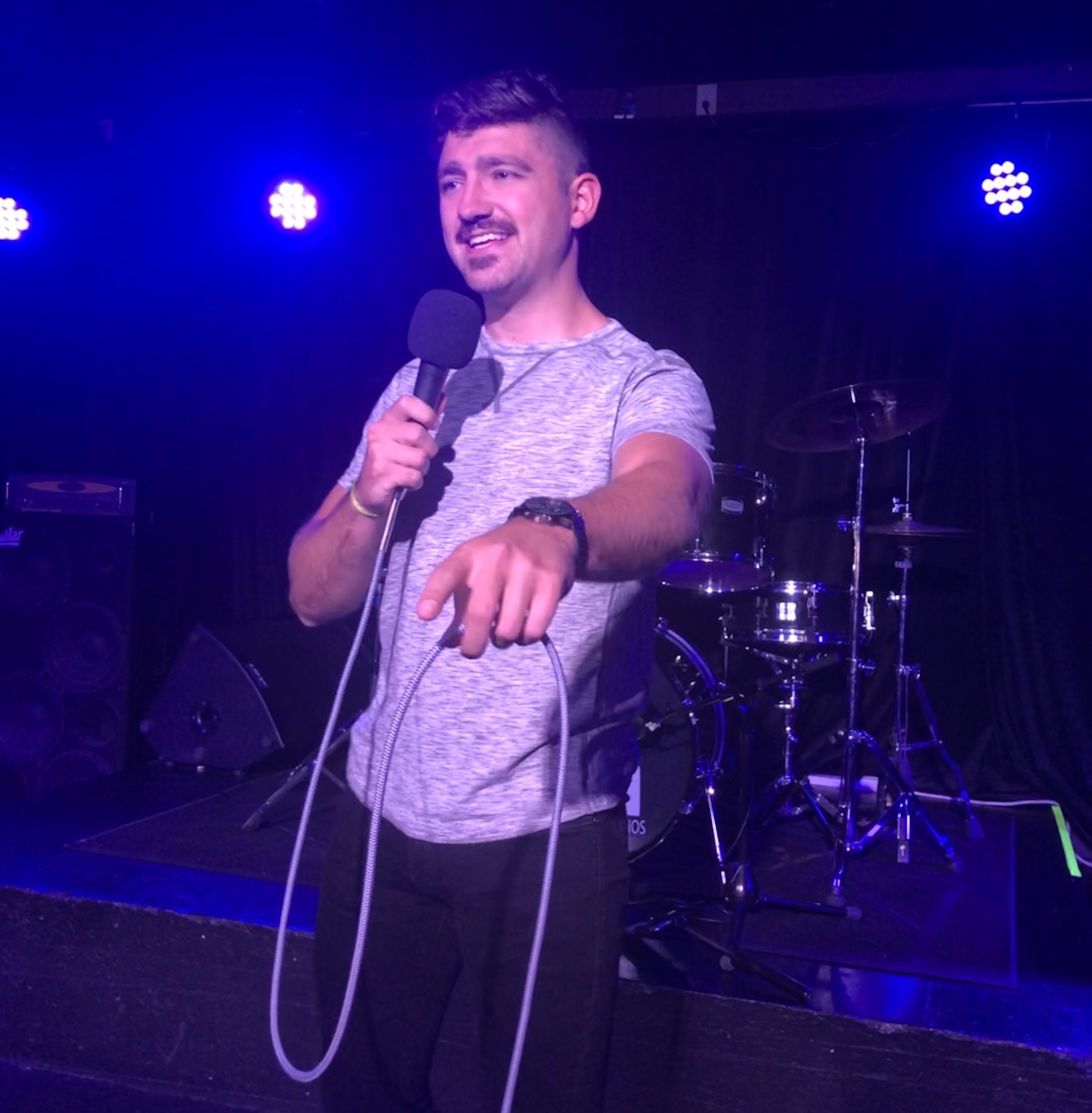
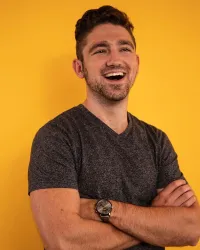
Who Is Wayne Veldsman?
Wayne Veldsman, owner of Vel.Consulting and Journey To Legacy, began his career by building several digital businesses out of his college dorm room....
Wayne is an accomplished business growth strategist, success coach, and entrepreneur. He specializes in helping entrepreneurial minded individuals to grow both their mindsets and their income.
After starting his first business in 2014, Wayne successfully launched and scaled a digital marketing agency to a 7-figure valuation before deciding to exit in 2019 to move to Denver, Colorado and start chasing his passion of coaching and public speaking.
Wayne actively works with entrepreneurs and businesses who are looking to take massive action and create drastic changes in their lives.
Not Sure How To Make The Drastic Change Necessary To Live The Life Of Freedom That Comes With Being A Lifestyle Entrepreneur?
Discover the stupid simple method to growing businesses digitally on autopilot, so that you can get back to your life.
Our students and clients aren't just satisfied, they're building life-changing businesses, doing what they want when they want, and living their lives chasing passion, not just profits.
Media Spotlights...




The 3-Step Strategy To Growing Businesses Digitally
Are you an Agency Owner, Service Provider, or Entrepreneur who sells online and want your pipeline filled with 300+ appointments with your idea client every single month? Are your SERIOUS about growing your business and want to work with Wayne 1-on-1?
Launch Into Digital Entrepreneurship is a course and coaching program specifically designed to take agency owners and online service providers from manual prospecting and wondering if this is ever going to work out, to having a very specific system in place which is going to allow you to generate 20 to 30 booked appointments every single day!
You're going to get a step by step process to building out your prospecting, sales and fulfilment system, and building your sales team so that you can close clients while stepping away from your sales process.
Price - $1,997 $97 (Limited Time Offer!)
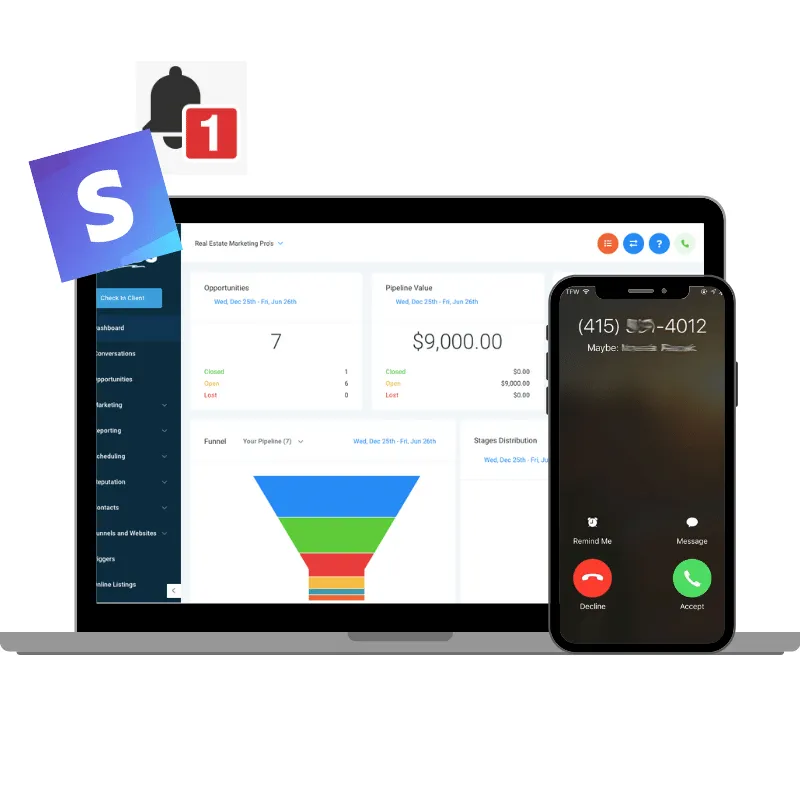
Every time we generate you a new lead interested in your marketing services, your dashboard will automatically add the new lead into your CRM, and send the new lead an SMS, email, and even automatically call you to connect you right away!
Become More Focused, Be More Productive, Burn Out Less
Price - FREE training
From The Desk Of Wayne Veldsman (blogs)
5 KPIs Every E-Commerce Store Owner Must Track Before Spending Another Cent on Marketing
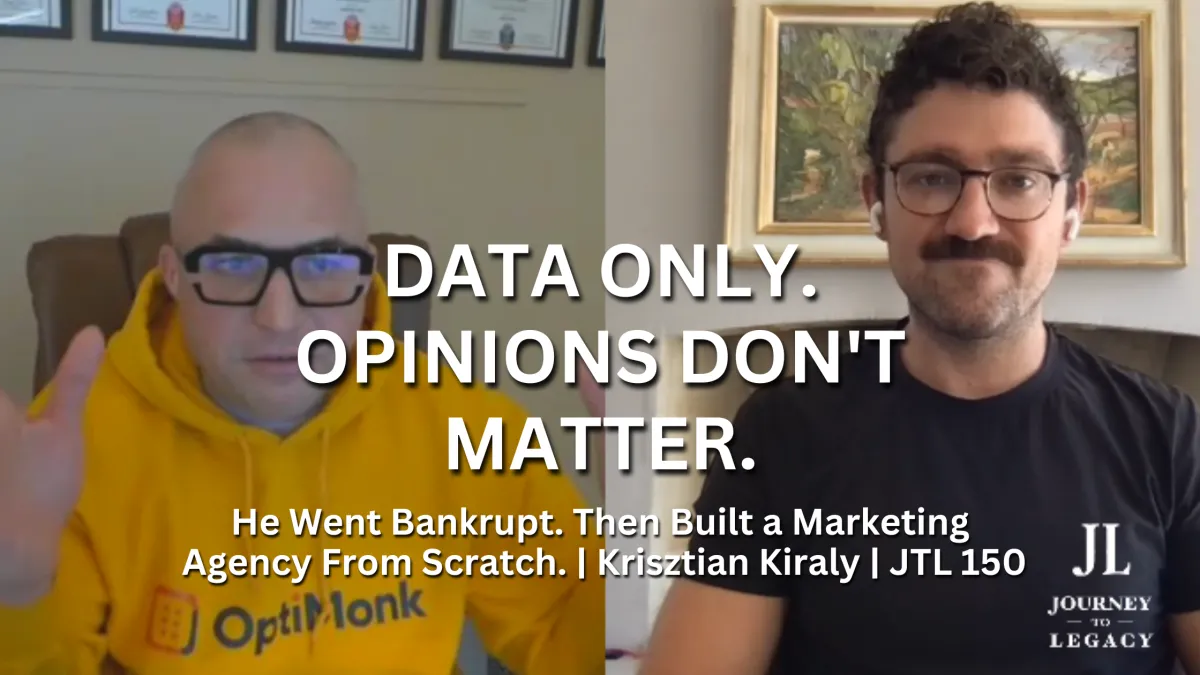
Want to hear the full conversation? Listen to the Journey To Legacy podcast Episode 150 with Krisztian Kiraly for even more insights and stories from his remarkable entrepreneurial journey.
5 KPIs Every E-Commerce Store Owner Must Track Before Spending Another Cent on Marketing
If you're running an e-commerce store and you've hired a marketer, an agency, or a freelancer - or you're thinking about it - there's one thing you absolutely need to know first.
You need to understand your numbers.
Not because you're going to run the campaigns yourself. But because without knowing your key performance indicators, you have no way of knowing whether the people you've hired are actually doing their job. You're essentially handing someone the keys to your business and hoping for the best.
I had a conversation with Krisztian Kiraly, International Partnership Manager at OptiMonk and a digital marketing veteran with over a decade of agency experience, and he made this point bluntly: "If you don't know the basic numbers, you can't check the quality of the work. You're just depending on them, and that's very dangerous."
So here are the five KPIs he says every e-commerce store owner needs to know - regardless of whether you ever touch a dashboard yourself.
1. E-Commerce Conversion Rate
This is the most important number on the list. Out of every 100 people who visit your store, how many actually buy something? If nobody's converting, it doesn't matter how much traffic you're driving. Visitors alone have never made anyone money.
A healthy conversion rate varies by industry, but knowing yours gives you a baseline. If it drops, something's wrong. If it improves, something's working. Start here.
2. Traffic Channel Performance
Where is your revenue actually coming from? Is it paid ads? Organic search? Email marketing? Social? You need to know which channels are sending you buyers, not just visitors. Once you know that, you can confidently invest more in what's working and stop wasting money on what isn't.
3. Return on Ad Spend (ROAS)
If you're running paid advertising - Meta, Google, TikTok, anywhere - you need to know your ROAS. For every rand or dollar you spend on an ad, how much revenue comes back? Krisztian's benchmark from his agency days was a minimum of 10x. Meaning for every R1 spent, R10 came back. If you're not hitting a strong multiple, you're bleeding money and you may not even know it.
4. Average Order Value (AOV)
How much does a customer typically spend in a single transaction? This number tells you a lot about the health of your store and opens up conversations about upselling, bundles, and product positioning. Small increases in AOV can have a significant impact on overall revenue without needing a single extra visitor.
5. Customer Acquisition Cost (CAC)
How much does it actually cost you to acquire one paying customer - not a click, not a session, a customer? This includes your ad spend, software costs, agency fees, and any other related costs. If your CAC is higher than what a customer spends with you, you're building a business that loses money at scale.
The Point Isn't Complexity - It's Clarity
Krisztian's broader philosophy is simple: opinions don't matter in digital marketing. Your opinion. Your marketer's opinion. Nobody's opinion. Only data matters. The PDCA cycle - Plan, Do, Check, Act - is how you build a store that improves over time rather than one that stagnates.
You don't need to become a data analyst. You just need to know these five numbers well enough to have an informed conversation with whoever is managing your marketing.
Because the stores that grow aren't the ones with the biggest budgets. They're the ones where the owner knows what the numbers mean and makes decisions based on them.
Want to go deeper? Listen to my full conversation with Krisztian Kiraly on the Journey to Legacy Podcast - available on Spotify, Apple Podcasts, and YouTube. He also shares how tools like OptiMonk are using AI to help e-commerce stores personalise their customer experience at scale. Use code JTL50 for 50% off your first three months at OptiMonk.com.
Transcript
Wayne: What happens when you build a whole career, only to realize one day that the life you created is no longer the life you want. Welcome back to Journey to Legacy. I'm your host Wayne Veldman, and in today's episode I sit down with Krisztian Kiraly from OptiMonk to talk about a powerful reinvention story. Krisztian shares how he went from spending more than 15 years working and building a career on cruise ships to hitting burnout, losing his first business after having to file bankruptcy, and then rebuilding his life from the ground up through digital marketing, entrepreneurship, and constant learning. During the interview, we also get into actionable advice around what it really takes to build an e-commerce brand, why opinions don't matter nearly as much as data, and how AI is changing the future of online marketing through hyper-personalization. This is a conversation about growth, hard pivots, and what it really takes to stop living a life that's just good enough. Enjoy.
Wayne: Hey my friend. Thank you so much for being here today.
Krisztian: Thank you very much for the invitation, Wayne. I really appreciate it and thank you for being here with you together.
Wayne: Yeah, absolutely. I'm excited by some of the things you've told me already from your journey that we've shared today and the other day when we first met. But kick us off. Tell everybody that's listening that's not familiar with you, a little bit about who you are and what you're working on today.
Krisztian: Actually, I'm originally a digital marketing expert for more than a decade now, and I think as everybody else in this niche, I have started as a side hustle beside my main job. Then later on I have started as a freelancer. I've done just alone everything. That time it was still possible in digital marketing, or a kind of that. And then later on I have built my own digital marketing agency here in Hungary. It was a full stack digital marketing agency, which I led for more than five years. And at the moment I'm working as an international partnership manager at OptiMonk, a B2B SaaS company. And actually our software is a very comprehensive AI powered CRO tool for conversion rate optimization.
Wayne: Beautiful Krisztian. So you were running an agency for a long time, said sort of full stack, right? So you were sort of holistic. Was there a certain niche that you focused more on, a certain service, or what did that agency look like?
Krisztian: Very good question. So actually I believed, and I still believe, regarding digital marketing in a holistic approach, which means I know there are definitely some agencies that are focusing only on email marketing, only on SEO, only on PPC, which is quite good. And of course you can also achieve some results. But to my opinion, to my experience, the biggest impact, the biggest results for clients, you can achieve every time when you manage all the areas of digital marketing all together. And then they are working in a kind of synergy. And from that reason, it was also, as I have mentioned before, a full stack digital marketing agency. So we have done all the services for our clients — web development, PPC campaigns, SEO, and of course one of my favorite areas, CRO, conversion rate optimization. And we were focusing definitely on e-commerce stores.
Wayne: You know, Krisztian, I totally agree with you in the sense of you want to be holistic when it comes to your marketing efforts, not just do pay-per-click advertising, not just focus on your website or social. What about for smaller brands that don't have the revenue, they don't have the staff and manpower to do everything? What do you suggest that they start with?
Krisztian: For them, actually, it's very easy. They don't need a full stack digital marketing agency yet. So I think it's very important on a journey, for example, as an entrepreneur or an e-commerce store owner, to always set a priority list. I mean, there are always a lot of stuff to do, tons of tasks to do, but it's very important to set up a priority list. I suggest always to make a kind of bottleneck analysis. So where is the point in your system, in your website, in your business, where you can achieve the biggest impact with the least investment of time, energy, and money? And based on that, you can identify these bottlenecks and you can start with them.
So just back to your question — for example, okay, you are a solo entrepreneur. You have just started your business, a small e-commerce store. Definitely you don't need a full stack digital marketing agency yet. You don't need those services. And actually you can't afford them to pay, but you don't need it because at the beginning, what do you need? You need visitors. You need traffic. Which one is the fastest way, and hopefully also the most efficient way, to get visitors? Just run some PPC campaigns, either Meta ads or Google ads. Just start with a small budget and run your first campaigns to get your first visitors. And then of course you have to set up your measurement system from the beginning so that you can measure everything. We know it exactly — what you don't measure, you can't improve. So if you have your measurement system, you can start later on to scale because based on that data, you know already what is working for you and what is not. And then it's a never ending story. A website or an e-commerce store is never perfect. It will never be ready. But that's actually the most beautiful part of it.
And I also very much love to use as a workflow the PDCA cycle. It's coming from Eduard Deming. The four letters stand for Plan, Do, Check, Act. So plan something. Make assumptions, make a hypothesis — it will work or it won't work. Do it, so implement it. Check — very important — measure it, measure the data. And based on that data, act. If it's working, start scaling. For example, double your budget for Meta ads. If it doesn't work, just stop it to avoid losing money. And then start again from planning. And of course, very important — please make data driven decisions. The one thing that definitely never counts in digital marketing is opinion. My opinion, your opinion, your mother's opinion, your friend's opinion — sorry, it doesn't matter. Data. Only data is important.
Wayne: Nice. Krisztian, I appreciate all of this. It's great that you explain that if you're just starting out with an e-commerce store, first you need more eyeballs, you need more visitors, you need more traffic. So start with whatever the simplest route of that is. A lot of times that's simple online advertising, a social media advertising campaign. And then the second most important thing you mentioned is set up the system to collect data, to track and analyze performance. Then you swung all the way around there at the end with "please make data-driven decisions." Can you think back to when you first learned this? Like what was going on in your digital marketing experience when you realized opinions don't matter, make data-driven decisions?
Krisztian: Very good question, Wayne, because it's actually before my career as a digital marketer. One of my biggest pitfalls or failures was my first business, which I started as an e-commerce store but without any knowledge. It's a long time ago, maybe 15 to 20 years ago. And at that time the marketplace was not so overcrowded, but you definitely still needed knowledge. But I lacked that knowledge. And unfortunately, or maybe fortunately — it depends on how we look at it — this business went bankrupt, and exactly from this reason: because I didn't measure anything. I didn't know anything about what was actually going on in my business. I just saw the numbers, the results were very poor. Of course, I had spent tons of money on different ways of advertising, but nothing happened. The number of purchases was very low. So after a time, I had to close it because I couldn't afford to invest more money, time, and energy into it.
So through my own sad experience, I had to learn — okay, I have to deepen my knowledge regarding this. I have to understand how does it work. What does it mean to look at the most important numbers, the KPIs, the key performance indicators. And actually with that started my new journey, because I discovered that I actually enjoyed learning all this stuff, attending these courses. And then I discovered — this could be something for me as a new career path. And that was the reason I chose: from that moment, I would like to be a digital marketer. One part was not so fun, of course, because I lost a lot of money, but on the other part, I found my new passion.
Wayne: Of course. It was almost meant to be, right? That this first e-commerce business was meant to fail, but through that process you found your passion. Krisztian, I want to take it back a little further. Take us even a little further back, because a lot of times we hear from experts like yourself and we think, oh well they've been doing this forever. But I like to share journeys and especially pivots that people make from one career and old lifestyle into a new one. So tell everybody a little more about your background and how you got to where you are today.
Krisztian: Okay, so in my case it was actually a huge change because I started my career in an absolutely different area of life — on cruise ships. I was working on cruise ships for more than five years on ocean liners, and later on for more than a decade on river lines, most of the time by German companies. And I actually made all of the positions which were possible on board of a cruise ship. So I started as a deck steward, just carrying chairs on the decks and towels for the passengers. And later on I was promoted again and again. I was working at the reception. I was an animator. I was a host. I was working also in the excursion department and so on.
And later on in 2005 I was promoted to cruise director, which is one of the leading positions on board of cruise ships. And then I changed to river ships, and I spent there also more than 10 years. And at the end of my career I was already a senior cruise director, so my biggest task was to teach the new cruise directors at the company.
But after 15 years, I must be very honest — I just felt a kind of burnout. It was not exciting for me anymore. I didn't enjoy it anymore. And I think it's very important in your life that your job, your work, where you spend most of your time, that you enjoy it. So I made the decision that I definitely needed a change. Because I also felt that you can't have a normal life on board of a ship. You don't have any possibility to have real friendships, and of course you don't have a possibility to have a real family. So at that age I made the decision — okay, it's a very attractive career and I achieved a lot there, but I need a change in my life because I would like to change my future. I don't want to get old on board of a ship alone.
So it was a big question for me — okay, what to do as a next step? Because I had to acknowledge that even if I had a big position and big career on board cruise ships, it didn't have any value on land, on shore side. So okay, I have to learn something new so I can deliver value again to the market. And then I started working in a customer success team in a small company in Hungary. And it was at the same time when I started my entrepreneurship. Okay, maybe I'm not the perfect employee, but I'm a good businessman, so I can start my own business because I know everything. I had a big career on board, so everything is possible for me — with that mentality, of course, which is quite funny now. But at that time I really thought it was just enough to know this and I would be successful also in the e-commerce niche.
Wayne: Yep.
Krisztian: We know already the end of the story. I lost almost everything with that e-commerce store. But I got my new passion. So at that time I still had my main job working in that customer success team. But as a side hustle — early in the morning and late in the evening at home — I started very intensively to learn, to deepen my knowledge regarding digital marketing. So firstly I started to attend all the courses which were available in Hungary. Then I discovered that if I would like to achieve the next level, I had to improve my English because at that time my first foreign language was German and my English was very poor. So I started to improve my English in order to understand the courses and knowledge bases. And what you can see behind me on the wall, which I'm very proud of — in total I have attended and successfully completed 25 different certificates and international courses in digital marketing.
Okay, now I have a lot of theoretical knowledge. Now let's get to the practical knowledge. So I need clients or agencies to work with. So I started to apply for jobs at digital marketing agencies. And it's also very funny to look back — I was refused by all of them. Every time I either didn't get any answer or I got: "It sounds good, but you don't have any experience yet." Okay, but it's a catch-22. How should I gather experience if I don't get the possibility to get a job as a digital marketer?
So I was a little bit disappointed, but never give up. I came up with the idea — okay, if I don't get the chance to work at an agency, then I need my own clients. So I started with cold outbound, which was not so common at that time, to be honest. What I did was I randomly found companies with websites or e-commerce stores, I analyzed their site, made a Loom video about it with my ideas, suggestions, and tips on how to fix their issues, and I just sent them this recorded Loom video to show them my expertise, to show them my knowledge, to show them that I can deliver value and help them. And as I remember, I made more than 70 of those Loom videos. And so I got my first clients with this method. I could start as a freelancer beside my main job. And later on I had enough clients to actually choose only my solo entrepreneurship. And the rest is history.
Wayne: So did you ever actually land a job at an agency through this whole process?
Krisztian: Never.
Wayne: What?
Krisztian: So afterwards it was challenging for me, to be honest, to build up my own digital marketing agency without any experience of how it works inside. So it was again a journey for me to seek out information, to attend courses, so that I could deepen my knowledge regarding this — how to behave as a CEO, how to manage a whole digital marketing agency with all the colleagues and subcontractors, client management and so on.
Wayne: It's so much. I mean, making even this pivot from working in the cruise industry, working with mostly people in person, to something that's completely different — online business is such a huge pivot. And you even said that you'd reached this level of burnout, that you realized this isn't sustainable for your life, creating and starting a family, that was why you had to make this pivot. Krisztian, I'm curious — do you think that in order for people to make such big pivots in their life, they have to first reach a level of rock bottom before they realize change needs to be made? Or how can we almost see it in ourselves to take action today before we reach a more drastic level that forces us into a different direction?
Krisztian: I think it depends on your mindset, on your mentality, because I really often hear and also see that people don't change in their life because the pain is not big enough yet. If they recognize that something is already not right in their life, and then they are ready to make that decision and follow through on it. Or they wait until they get to rock bottom. And then it hurts — but then it really hurts. I speak from my own experience. It's not the best way. So I definitely recommend that if you see already the first signs that something is going wrong in your life, then choose to change sooner rather than later. Because later on it'll be much harder.
And I've heard a quote — I try to translate it into English because I heard it in Hungarian — but I really love it: the biggest hurdle for a perfect life is a nice enough life. Can you understand me?
Wayne: Absolutely.
Krisztian: It's a very big danger, I think. The comfort zone. Most people are living in the comfort zone and they don't even recognize that they are living absolutely under their potential. But it's nice enough. It's a big danger.
Wayne: It's a huge danger. How do we recognize it? How do we work through it? It's exactly as you said, right? If the pain isn't great enough, then we're not going to take action. I had just a quick side story — I had a first job that was in sales and I told my employer: "I'm just not that money motivated." I was in my comfort zone. I was making enough. I'm not driven by fancy cars or watches. And she told me: "Well, if you're not that money motivated now, it's because you don't have enough expenses." She said I should go buy a more expensive car, move into a more expensive place. And so now your monthly bills aren't big enough — once they are, you'll feel this pain of "I have to make this much money" and that will push you forward. I don't think that's great advice, right? To overextend yourself financially. But it's absolutely one direction you could go.
But yeah, Krisztian — how can we almost fast forward people to realize that even though you're comfortable today, now is the time to take action?
Krisztian: I can tell you what was the situation in my case from my own experience. Two important things. Firstly, that my life wasn't improving in any area, and we know exactly that stagnant just doesn't exist. There is either improvement or decline. And that was exactly the point I discovered — okay, nothing changes. What I discovered in myself at that time was really painful and shocking — I had stopped learning. I stopped reading books. Because earlier in my younger years I was hungry for knowledge, for learning, for reading. But I had just stopped. Also, nothing changed in my financial life. I just looked around — okay, I had a nice car, I had a nice apartment, but no improvements, nothing that really matters.
And the second part, which is also very important — I'm sure you know this quote: show me your friends and I'll show you your future. I just looked around and discovered that when I took a close look at my five closest friends — is this actually the life I imagine for myself for the next five or ten years? Because at that time I was single. I had a nice life, but actually nothing meaningful. Same for all my friends — just single, having some parties, but nothing with real goals, nothing with meaningful motivations. And it's very dangerous because you don't recognize it because it becomes normal. The everyday conversations: what are we gonna do this weekend? Let's go to this party. After a while you think it's normal.
So these are the two points where I discovered — okay, this is not okay for me, Krisztian. This is exactly not how you imagined your life when you were a child or a teenager. So if you would like to have a different future, you have to change something now in your present. And that was the main point where I started to drastically change everything in my life. Started again reading, started again doing courses and so on.
Wayne: Beautiful. My friend. This piece that stuck out to me the most is that you said — stagnant, staying in the same place, doesn't exist. It's either growth or decline. So if you believe that you're staying the same, that's actually decline.
Krisztian: It is the same for business. It's the same for your private life. Whatever we look at, it's the same situation. Because the whole world is always changing. Stagnant just exists in your fantasy.
Wayne: Oh, it's all changing so fast. And so if we are not growing, moving forward, changing — we're absolutely in decline. So if you find yourself in that comfort zone and you look back at your year or two years and you're essentially in the same place, that should really make you feel that pain of — let's have growth, let's keep moving forward.
Krisztian: Wasted time. And this is really crucial when you think about it. You can make as much money as you wish, but your time is limited. 24 hours per day, that's all. And X amount of years — who knows? But it's definitely limited. So take care how you spend it because yesterday you will never get back again. It's gone forever.
Wayne: Absolutely. You'll never get that time back again. So Krisztian, let's fast forward a little bit to today, to OptiMonk, because you all have developed a tool that is absolutely skyrocketing e-commerce businesses and it's because you all are adapting new technologies and specifically AI. So tell everybody just a little bit more — what is OptiMonk working on and how are you all continuing to move forward?
Krisztian: Yeah, actually I think it's a very exciting area. So actually OptiMonk started about 12 years ago just as a classic popup tool, but with time we discovered that it's definitely not enough to stay in this overcrowded space of e-commerce. So we developed, always added new features — like for example, built-in AB testing. And nowadays I would say that OptiMonk is a very comprehensive AI powered CRO tool for conversion rate optimization, which makes for e-commerce stores, but also for websites of course, without the need of developers — just with very easy to use features to increase your average order value, increase your conversion rates, accelerate your signup rates, build your email or SMS list. And of course a built-in AB testing tool in order to measure everything and make data-driven decisions. You have a very detailed data analytics dashboard in your OptiMonk account where you can follow all the KPIs — like impressions, click-through rates, and of course assisted revenue through the campaigns, how the different AB versions performed. So you can see all the important data and numbers which you need in order to make data-driven decisions.
Wayne: So OptiMonk started as a tool that was essentially a popup on a website to collect people's name, email, phone numbers to grow your subscriber list. And now it's become such a bigger, encompassing tool to help businesses online. And so you've seen a lot of e-commerce businesses. What separates the businesses and stores online that are growing versus those that aren't?
Krisztian: Very good question, and it's not so easy to answer. So actually at the moment about 30,000 websites and e-commerce stores are already using OptiMonk worldwide. So we have a huge pool of data to learn from. And of course we are also running tons of AB testing. So therefore I would say that firstly, the most important thing which makes a difference between growing and not growing e-commerce stores is definitely the data — as we started our conversation. It's very important for you as an e-commerce store owner to know all your data, or at least the most important KPIs, and then to start testing. It's a never ending story. Make assumptions and start testing what works and what doesn't work in your industry for your visitors.
And for example, to regularly make a deep analysis — qualitative and quantitative. Quantitative analysis means making a data analysis with the help of your Google Analytics. It's free of charge. Or even if you use Shopify, there are tons of data in your admin dashboard. Just look at it, just use it, just know your KPIs. And sometimes it's also very worthwhile to make a qualitative analysis, which means just gather some feedback from your visitors in order to know how to improve your e-commerce store.
And it's also a difference that I see — some e-commerce store owners set up the store, because it's nowadays very easy with just drag and drop in not even one day, and then they are just sitting around waiting for results. But it doesn't work anymore because the world is changing. So you have to always learn new ways, new things to improve your e-commerce stores. Start testing new ways. Gather feedback from your visitors. There are tons of tools out there, even sometimes free of charge, like Hotjar or Crazy Egg. With the help of these tools, make some heat maps. Look at some session recordings — how do your visitors behave on your site? Where do they click? How do they scroll? In order to gather insights and based on those insights to make some changes on your product page, or wherever it's necessary.
Wayne: Beautiful. Look at the data, keep making adjustments, keep testing, keep moving forward. Okay, what about for people that had a passion — let's say I'm just a painter, I love making art, and so now I want to start selling it. I'm going to go to Shopify, launch an e-commerce store to sell my paintings. Krisztian, I don't love data. I'm not a marketer. I'm a painter. What should I do, where do I start?
Krisztian: Okay, regarding this I have for you as an artist two bad news. Let's start with the first one. Even if you are not interested in digital marketing as an entrepreneur, as a business owner, you have to know at least the most important KPIs. You don't have to know everything deeply about digital marketing, of course, but at least the most important KPIs. Because otherwise, how could you validate if the freelancer or digital marketing agency you're working with are doing their job correctly or not? If you don't know the basic numbers, if you don't have the possibility to check them, you are depending entirely on them. And it's very dangerous. So at least the most important KPIs — you have to know them. In order to know — is this the correct freelancer? Is this the right agency for me or not? Can I believe the reports they're showing me? Or is it just a fairytale?
Wayne: What would you say are the metrics that people should be looking at? What are the most important key performance indicators that people should be aware of?
Krisztian: Okay, very good question. So first of all, the most important KPI for an e-commerce store is the e-commerce conversion rate. From a hundred visitors, how many purchase? That is the most important KPI because I always say — visitors just looking around in your e-commerce store have never earned anyone any money in the history of e-commerce. So — e-commerce conversion rate.
Then, which is your most important traffic channel? Which delivers the biggest revenue for you? It could be PPC, it could be organic traffic, it could be email marketing, whatever. But know your traffic channels in order to know — okay, this traffic channel works for me, this one doesn't. To make data-driven decisions, in order to know which channel is worth scaling, increasing your budget for, or which should you maybe just shut off because it doesn't work for you.
Okay, thirdly — if you are running PPC campaigns, whether Meta ads or Google ads, know your ROAS — return on ad spend. Which means: if I spend one dollar for this campaign, how much revenue will be generated from that one dollar? It should be at least five times ROAS. For example, earlier as a digital marketing agency owner, our goal was at least 10 times — from one US dollar we make ten. And it's the same actually for email marketing. You have some costs — the email marketing software, the colleagues doing the newsletters. So you have to know exactly how much revenue will be generated from email marketing specifically. Because okay, you could have 10,000 subscribers, but if the open rate or the click-through rate is very low because of poor quality newsletters, and then you have just a few visitors from your newsletter and they never purchase anything — even if you have 10,000 subscribers, it actually doesn't have any measurable value. That's very important.
Wayne: I think those are great. Nice and simple. Three different ones — what is the actual conversion rate of your store per visitors, how many people are actually converting into customers that are purchasing? Number two, being able to understand which traffic channels are successful, which bring you the most traffic that actually converts into customers. And then finally return on ad spend.
Krisztian: Or just return on investment. ROI. We can use that as well if you don't run ads.
Wayne: Return on investment for whatever investment you have for whatever traffic channel that might be. If it's email marketing, how much are you paying somebody to write those emails? What does the software cost? All of those costs together, and then directly how much revenue is coming in from that channel. So understanding those three — now you're able to actually challenge your marketing team to make sure that they are profitable, that there is growth.
Krisztian: Maybe two additional KPIs which I would also like to mention. Average order value — how much customers usually spend in your e-commerce store. Also a very important KPI. And customer acquisition cost — how much does it actually cost you to acquire a paying customer? Not a visitor, not a click. A customer. Customer acquisition cost. These two KPIs I think are also important.
And actually, the other bad news regarding this — if you are not able as a business owner to establish an excellent product market fit, we can make the best digital marketing strategy in the world, we can make the best campaigns for you, but it just won't work. Never. If your prices are too high, if the competition is too high, if you don't know exactly who your ICP is, your ideal customer profile. Because you say — oh, actually I can sell to anybody. If you sell to everybody, you sell to nobody. We know that exactly. So if these requirements aren't met, it's not depending on the freelancer, it's not depending on the agency. You can choose the best experts in the world — it still won't work. Especially nowadays, because with the help of AI agents it takes about two minutes to look around the market and find the right product if you are looking for something.
Wayne: And I have a funny story, which is actually based on a true story that happened to me maybe one month ago. And especially regarding paintings, since you mentioned the topic.
Krisztian: I had an online consultation with an e-commerce store owner who sold paintings. And before the consultation, of course I always prepare. So I checked the store, and what was a little bit confusing for me was that everywhere on the product pages it was written "hand painted paintings." But for me it looked a little suspicious — kind of AI generated. But I wasn't sure. Okay, can happen.
So we had the consultation. We were talking about different questions and topics, and I asked directly — actually, could you please clarify? Because you write that they are all hand painted paintings, that's the reason for the high prices, but for me they look AI generated. And he said literally to me: "Yes, yes, they are actually AI generated, but we thought it sounds better if we write that they are hand painted."
So at that moment it was a red flag for me because I knew we would not be working together. Never lie. Firstly for ethical reasons — it's cheating, just lying to the visitors. And on the other part — they showed me their data and the numbers. The reason they were applying for a consultation with me was that they had very big issues regarding their digital marketing strategy. They had run PPC campaigns, Google ads, Meta ads. The click-through rate was genius — so the ads were absolutely okay. They had tons of visitors on the site. The conversion rate was almost zero. Nothing.
Why? Because people are not stupid. They came to the site, thousands of them. And I assume they had the same feeling as me — for an AI made painting, which is not hand painted, why should I pay 400 or 500 bucks? I can just print it at the corner store for fifty dollars. People are not stupid. And of course it didn't work. That's exactly what I explained before — if the product market fit is not right, you can make the best campaigns in the world — in real life it won't work.
Wayne: Nice. Thanks for sharing. Yeah, absolute proof. I mean, lots of different problems in that story, starting with ethics.
Krisztian: I was shocked anyway. Imagine when I heard it — "Yes, yes, actually that's true. But we thought it sounded better." Yeah.
Wayne: Well, there you go. You're destined to fail. We have to slowly start to wrap up here, but I'm curious — with AI being such a big thing, where do you think AI is going? How do you think it's going to change how digital marketing looks over the next five years?
Krisztian: I think that AI makes all the workflows, all the testing, and drawing conclusions from a huge amount of data much faster than was ever possible before. So I see it already — it's happening right now — that for the tasks where we needed two or three colleagues five or six years ago, now we need just one colleague with the help of different AI tools.
But on the other part, I definitely also see the positive sides and advantages of that. Because exactly from this reason, with the help of AI, now it's also possible — which we were talking about for a couple of years but it was just not possible to implement. Just one example: hyper-personalization. We know exactly that the future of e-commerce is segmentation and personalization. Nobody wants to see general messages anymore. I have seen a case study — nowadays 68% of visitors and customers expect a personalized experience while browsing on a website or e-commerce store. And let's be honest, with normal tools it's not so easy.
But nowadays with the help of AI — just for example in our case with OptiMonk AI — it's now also possible to make hyper personalized on-site messages and popups, which means it's now possible to show every visitor a different popup with a different picture, a different headline, a different message — for example, based on the search intent. And this I think is very nice because it definitely increases the customer experience. "Wow, they know me, they know what my preferences are, what I'm looking for." And of course it's also good from a business standpoint because higher relevance equals higher conversion rates. So I think that with the help of AI, every area of digital marketing will be much faster and much easier. And regarding conversion rate optimization specifically, running tests and drawing conclusions from data with the help of AI is much easier and quicker than ever before.
Wayne: Huge advantages. I mean this idea of hyper-personalization — changing the titles, the headlines, the descriptions, the images based on every individual person that lands on a website. It's pretty mind blowing that it can be done. For anybody out there that wants to come and try OptiMonk — where do you suggest they go?
Krisztian: Okay, it's actually very easy and simple. Just go to optimonk.com. You can look around, gather more information about our tool. But I think the easiest way is not just to read about it but also to test it. So just register for a free OptiMonk account. There is actually a forever free account as well so you can test it, look around, implement it on your own website or e-commerce store and see with your own eyes the first results it can deliver for you.
And if you choose later on to upgrade to a paid plan — we have a special offer for your listeners, Wayne. We have a special coupon code: JTL50. And if you use this coupon code during registration, you get 50% discount for the first three months.
Wayne: Krisztian, appreciate it. I'll be signing up as well. And definitely thanks for the coupon code — JTL50. As we start to wrap up, I like to ask all of my guests — when you hear legacy, what does that even mean to you? And what's the legacy that you're looking to leave on this world?
Krisztian: I would say it's a kind of journey for every human being, because also from my experience, at the beginning of my journey I much admit I didn't take care so much about legacy. For me the most important thing was to achieve my own goals, to secure my financial life and establish everything which I needed. With time I think you discover that there is definitely more — not just what you can achieve in your own life. But it's a very big, very compelling feeling when you feel that you also have an impact on others' lives.
And that's exactly what I feel when I can make a speech — because I'm a passionate educator. I have my own YouTube channel, I'm also a keynote speaker at different events. And for me the reason for that is that I can help, I can educate business owners and e-commerce store owners so they avoid the traps and pitfalls that I made during my life. And I fortunately also get some feedback from clients or from people who attend my courses or speeches that they really enjoyed it and had a takeaway, that they learned something from that. And that's a kind of legacy where I feel okay, I have done not just something for me and for my close environment, but also for other people. And it's a very cool feeling. I love it and I enjoy it.
Wayne: It's the best, Krisztian. I love when I get to hear from experts, successful entrepreneurs like yourself, that legacy isn't just about making billions of dollars and leaving that to your family. It is the impact that you get to make on others. And for you specifically, you're talking about education, teaching — that the greatest value is actually sharing and showing others how they too can walk a similar path to yours. That's a pretty great definition of legacy right there.
Krisztian: Thank you very much.
Wayne: Krisztian, appreciate you greatly. Everybody out there that wants to learn more — check out the links in the show notes. Go check out optimonk.com, use the code JTL50. And Krisztian, I'd like to already invite you back in the future, my friend. I think there's so much more stuff we can talk about. Everybody go follow Krisztian on his YouTube channel as well. Greatly, greatly appreciate it, my friend.
Krisztian: Thank you, Wayne.
The 3-Step Strategy To Growing Businesses Digitally
Are you an Agency Owner, Service Provider, or Entrepreneur who sells online and want your pipeline filled with 300+ appointments with your idea client every single month? Are your SERIOUS about growing your business and want to work with Wayne 1-on-1?
Launch Into Digital Entrepreneurship is a course and coaching program specifically designed to take agency owners and online service providers from manual prospecting and wondering if this is ever going to work out, to having a very specific system in place which is going to allow you to generate 20 to 30 booked appointments every single day!
You're going to get a step by step process to building out your prospecting, sales and fulfilment system, and building your sales team so that you can close clients while stepping away from your sales process.
Price - $1,997 $97 (Limited Time Offer!)
Every time we generate you a new lead interested in your marketing services, your dashboard will automatically add the new lead into your CRM, and send the new lead an SMS, email, and even automatically call you to connect you right away!
Become More Focused, Be More Productive, Burn Out Less
Price - FREE Training
From The Desk Of Wayne Veldsman (blogs)
5 KPIs Every E-Commerce Store Owner Must Track Before Spending Another Cent on Marketing
Want to hear the full conversation? Listen to the Journey To Legacy podcast Episode 150 with Krisztian Kiraly for even more insights and stories from his remarkable entrepreneurial journey.
5 KPIs Every E-Commerce Store Owner Must Track Before Spending Another Cent on Marketing
If you're running an e-commerce store and you've hired a marketer, an agency, or a freelancer - or you're thinking about it - there's one thing you absolutely need to know first.
You need to understand your numbers.
Not because you're going to run the campaigns yourself. But because without knowing your key performance indicators, you have no way of knowing whether the people you've hired are actually doing their job. You're essentially handing someone the keys to your business and hoping for the best.
I had a conversation with Krisztian Kiraly, International Partnership Manager at OptiMonk and a digital marketing veteran with over a decade of agency experience, and he made this point bluntly: "If you don't know the basic numbers, you can't check the quality of the work. You're just depending on them, and that's very dangerous."
So here are the five KPIs he says every e-commerce store owner needs to know - regardless of whether you ever touch a dashboard yourself.
1. E-Commerce Conversion Rate
This is the most important number on the list. Out of every 100 people who visit your store, how many actually buy something? If nobody's converting, it doesn't matter how much traffic you're driving. Visitors alone have never made anyone money.
A healthy conversion rate varies by industry, but knowing yours gives you a baseline. If it drops, something's wrong. If it improves, something's working. Start here.
2. Traffic Channel Performance
Where is your revenue actually coming from? Is it paid ads? Organic search? Email marketing? Social? You need to know which channels are sending you buyers, not just visitors. Once you know that, you can confidently invest more in what's working and stop wasting money on what isn't.
3. Return on Ad Spend (ROAS)
If you're running paid advertising - Meta, Google, TikTok, anywhere - you need to know your ROAS. For every rand or dollar you spend on an ad, how much revenue comes back? Krisztian's benchmark from his agency days was a minimum of 10x. Meaning for every R1 spent, R10 came back. If you're not hitting a strong multiple, you're bleeding money and you may not even know it.
4. Average Order Value (AOV)
How much does a customer typically spend in a single transaction? This number tells you a lot about the health of your store and opens up conversations about upselling, bundles, and product positioning. Small increases in AOV can have a significant impact on overall revenue without needing a single extra visitor.
5. Customer Acquisition Cost (CAC)
How much does it actually cost you to acquire one paying customer - not a click, not a session, a customer? This includes your ad spend, software costs, agency fees, and any other related costs. If your CAC is higher than what a customer spends with you, you're building a business that loses money at scale.
The Point Isn't Complexity - It's Clarity
Krisztian's broader philosophy is simple: opinions don't matter in digital marketing. Your opinion. Your marketer's opinion. Nobody's opinion. Only data matters. The PDCA cycle - Plan, Do, Check, Act - is how you build a store that improves over time rather than one that stagnates.
You don't need to become a data analyst. You just need to know these five numbers well enough to have an informed conversation with whoever is managing your marketing.
Because the stores that grow aren't the ones with the biggest budgets. They're the ones where the owner knows what the numbers mean and makes decisions based on them.
Want to go deeper? Listen to my full conversation with Krisztian Kiraly on the Journey to Legacy Podcast - available on Spotify, Apple Podcasts, and YouTube. He also shares how tools like OptiMonk are using AI to help e-commerce stores personalise their customer experience at scale. Use code JTL50 for 50% off your first three months at OptiMonk.com.
Transcript
Wayne: What happens when you build a whole career, only to realize one day that the life you created is no longer the life you want. Welcome back to Journey to Legacy. I'm your host Wayne Veldman, and in today's episode I sit down with Krisztian Kiraly from OptiMonk to talk about a powerful reinvention story. Krisztian shares how he went from spending more than 15 years working and building a career on cruise ships to hitting burnout, losing his first business after having to file bankruptcy, and then rebuilding his life from the ground up through digital marketing, entrepreneurship, and constant learning. During the interview, we also get into actionable advice around what it really takes to build an e-commerce brand, why opinions don't matter nearly as much as data, and how AI is changing the future of online marketing through hyper-personalization. This is a conversation about growth, hard pivots, and what it really takes to stop living a life that's just good enough. Enjoy.
Wayne: Hey my friend. Thank you so much for being here today.
Krisztian: Thank you very much for the invitation, Wayne. I really appreciate it and thank you for being here with you together.
Wayne: Yeah, absolutely. I'm excited by some of the things you've told me already from your journey that we've shared today and the other day when we first met. But kick us off. Tell everybody that's listening that's not familiar with you, a little bit about who you are and what you're working on today.
Krisztian: Actually, I'm originally a digital marketing expert for more than a decade now, and I think as everybody else in this niche, I have started as a side hustle beside my main job. Then later on I have started as a freelancer. I've done just alone everything. That time it was still possible in digital marketing, or a kind of that. And then later on I have built my own digital marketing agency here in Hungary. It was a full stack digital marketing agency, which I led for more than five years. And at the moment I'm working as an international partnership manager at OptiMonk, a B2B SaaS company. And actually our software is a very comprehensive AI powered CRO tool for conversion rate optimization.
Wayne: Beautiful Krisztian. So you were running an agency for a long time, said sort of full stack, right? So you were sort of holistic. Was there a certain niche that you focused more on, a certain service, or what did that agency look like?
Krisztian: Very good question. So actually I believed, and I still believe, regarding digital marketing in a holistic approach, which means I know there are definitely some agencies that are focusing only on email marketing, only on SEO, only on PPC, which is quite good. And of course you can also achieve some results. But to my opinion, to my experience, the biggest impact, the biggest results for clients, you can achieve every time when you manage all the areas of digital marketing all together. And then they are working in a kind of synergy. And from that reason, it was also, as I have mentioned before, a full stack digital marketing agency. So we have done all the services for our clients — web development, PPC campaigns, SEO, and of course one of my favorite areas, CRO, conversion rate optimization. And we were focusing definitely on e-commerce stores.
Wayne: You know, Krisztian, I totally agree with you in the sense of you want to be holistic when it comes to your marketing efforts, not just do pay-per-click advertising, not just focus on your website or social. What about for smaller brands that don't have the revenue, they don't have the staff and manpower to do everything? What do you suggest that they start with?
Krisztian: For them, actually, it's very easy. They don't need a full stack digital marketing agency yet. So I think it's very important on a journey, for example, as an entrepreneur or an e-commerce store owner, to always set a priority list. I mean, there are always a lot of stuff to do, tons of tasks to do, but it's very important to set up a priority list. I suggest always to make a kind of bottleneck analysis. So where is the point in your system, in your website, in your business, where you can achieve the biggest impact with the least investment of time, energy, and money? And based on that, you can identify these bottlenecks and you can start with them.
So just back to your question — for example, okay, you are a solo entrepreneur. You have just started your business, a small e-commerce store. Definitely you don't need a full stack digital marketing agency yet. You don't need those services. And actually you can't afford them to pay, but you don't need it because at the beginning, what do you need? You need visitors. You need traffic. Which one is the fastest way, and hopefully also the most efficient way, to get visitors? Just run some PPC campaigns, either Meta ads or Google ads. Just start with a small budget and run your first campaigns to get your first visitors. And then of course you have to set up your measurement system from the beginning so that you can measure everything. We know it exactly — what you don't measure, you can't improve. So if you have your measurement system, you can start later on to scale because based on that data, you know already what is working for you and what is not. And then it's a never ending story. A website or an e-commerce store is never perfect. It will never be ready. But that's actually the most beautiful part of it.
And I also very much love to use as a workflow the PDCA cycle. It's coming from Eduard Deming. The four letters stand for Plan, Do, Check, Act. So plan something. Make assumptions, make a hypothesis — it will work or it won't work. Do it, so implement it. Check — very important — measure it, measure the data. And based on that data, act. If it's working, start scaling. For example, double your budget for Meta ads. If it doesn't work, just stop it to avoid losing money. And then start again from planning. And of course, very important — please make data driven decisions. The one thing that definitely never counts in digital marketing is opinion. My opinion, your opinion, your mother's opinion, your friend's opinion — sorry, it doesn't matter. Data. Only data is important.
Wayne: Nice. Krisztian, I appreciate all of this. It's great that you explain that if you're just starting out with an e-commerce store, first you need more eyeballs, you need more visitors, you need more traffic. So start with whatever the simplest route of that is. A lot of times that's simple online advertising, a social media advertising campaign. And then the second most important thing you mentioned is set up the system to collect data, to track and analyze performance. Then you swung all the way around there at the end with "please make data-driven decisions." Can you think back to when you first learned this? Like what was going on in your digital marketing experience when you realized opinions don't matter, make data-driven decisions?
Krisztian: Very good question, Wayne, because it's actually before my career as a digital marketer. One of my biggest pitfalls or failures was my first business, which I started as an e-commerce store but without any knowledge. It's a long time ago, maybe 15 to 20 years ago. And at that time the marketplace was not so overcrowded, but you definitely still needed knowledge. But I lacked that knowledge. And unfortunately, or maybe fortunately — it depends on how we look at it — this business went bankrupt, and exactly from this reason: because I didn't measure anything. I didn't know anything about what was actually going on in my business. I just saw the numbers, the results were very poor. Of course, I had spent tons of money on different ways of advertising, but nothing happened. The number of purchases was very low. So after a time, I had to close it because I couldn't afford to invest more money, time, and energy into it.
So through my own sad experience, I had to learn — okay, I have to deepen my knowledge regarding this. I have to understand how does it work. What does it mean to look at the most important numbers, the KPIs, the key performance indicators. And actually with that started my new journey, because I discovered that I actually enjoyed learning all this stuff, attending these courses. And then I discovered — this could be something for me as a new career path. And that was the reason I chose: from that moment, I would like to be a digital marketer. One part was not so fun, of course, because I lost a lot of money, but on the other part, I found my new passion.
Wayne: Of course. It was almost meant to be, right? That this first e-commerce business was meant to fail, but through that process you found your passion. Krisztian, I want to take it back a little further. Take us even a little further back, because a lot of times we hear from experts like yourself and we think, oh well they've been doing this forever. But I like to share journeys and especially pivots that people make from one career and old lifestyle into a new one. So tell everybody a little more about your background and how you got to where you are today.
Krisztian: Okay, so in my case it was actually a huge change because I started my career in an absolutely different area of life — on cruise ships. I was working on cruise ships for more than five years on ocean liners, and later on for more than a decade on river lines, most of the time by German companies. And I actually made all of the positions which were possible on board of a cruise ship. So I started as a deck steward, just carrying chairs on the decks and towels for the passengers. And later on I was promoted again and again. I was working at the reception. I was an animator. I was a host. I was working also in the excursion department and so on.
And later on in 2005 I was promoted to cruise director, which is one of the leading positions on board of cruise ships. And then I changed to river ships, and I spent there also more than 10 years. And at the end of my career I was already a senior cruise director, so my biggest task was to teach the new cruise directors at the company.
But after 15 years, I must be very honest — I just felt a kind of burnout. It was not exciting for me anymore. I didn't enjoy it anymore. And I think it's very important in your life that your job, your work, where you spend most of your time, that you enjoy it. So I made the decision that I definitely needed a change. Because I also felt that you can't have a normal life on board of a ship. You don't have any possibility to have real friendships, and of course you don't have a possibility to have a real family. So at that age I made the decision — okay, it's a very attractive career and I achieved a lot there, but I need a change in my life because I would like to change my future. I don't want to get old on board of a ship alone.
So it was a big question for me — okay, what to do as a next step? Because I had to acknowledge that even if I had a big position and big career on board cruise ships, it didn't have any value on land, on shore side. So okay, I have to learn something new so I can deliver value again to the market. And then I started working in a customer success team in a small company in Hungary. And it was at the same time when I started my entrepreneurship. Okay, maybe I'm not the perfect employee, but I'm a good businessman, so I can start my own business because I know everything. I had a big career on board, so everything is possible for me — with that mentality, of course, which is quite funny now. But at that time I really thought it was just enough to know this and I would be successful also in the e-commerce niche.
Wayne: Yep.
Krisztian: We know already the end of the story. I lost almost everything with that e-commerce store. But I got my new passion. So at that time I still had my main job working in that customer success team. But as a side hustle — early in the morning and late in the evening at home — I started very intensively to learn, to deepen my knowledge regarding digital marketing. So firstly I started to attend all the courses which were available in Hungary. Then I discovered that if I would like to achieve the next level, I had to improve my English because at that time my first foreign language was German and my English was very poor. So I started to improve my English in order to understand the courses and knowledge bases. And what you can see behind me on the wall, which I'm very proud of — in total I have attended and successfully completed 25 different certificates and international courses in digital marketing.
Okay, now I have a lot of theoretical knowledge. Now let's get to the practical knowledge. So I need clients or agencies to work with. So I started to apply for jobs at digital marketing agencies. And it's also very funny to look back — I was refused by all of them. Every time I either didn't get any answer or I got: "It sounds good, but you don't have any experience yet." Okay, but it's a catch-22. How should I gather experience if I don't get the possibility to get a job as a digital marketer?
So I was a little bit disappointed, but never give up. I came up with the idea — okay, if I don't get the chance to work at an agency, then I need my own clients. So I started with cold outbound, which was not so common at that time, to be honest. What I did was I randomly found companies with websites or e-commerce stores, I analyzed their site, made a Loom video about it with my ideas, suggestions, and tips on how to fix their issues, and I just sent them this recorded Loom video to show them my expertise, to show them my knowledge, to show them that I can deliver value and help them. And as I remember, I made more than 70 of those Loom videos. And so I got my first clients with this method. I could start as a freelancer beside my main job. And later on I had enough clients to actually choose only my solo entrepreneurship. And the rest is history.
Wayne: So did you ever actually land a job at an agency through this whole process?
Krisztian: Never.
Wayne: What?
Krisztian: So afterwards it was challenging for me, to be honest, to build up my own digital marketing agency without any experience of how it works inside. So it was again a journey for me to seek out information, to attend courses, so that I could deepen my knowledge regarding this — how to behave as a CEO, how to manage a whole digital marketing agency with all the colleagues and subcontractors, client management and so on.
Wayne: It's so much. I mean, making even this pivot from working in the cruise industry, working with mostly people in person, to something that's completely different — online business is such a huge pivot. And you even said that you'd reached this level of burnout, that you realized this isn't sustainable for your life, creating and starting a family, that was why you had to make this pivot. Krisztian, I'm curious — do you think that in order for people to make such big pivots in their life, they have to first reach a level of rock bottom before they realize change needs to be made? Or how can we almost see it in ourselves to take action today before we reach a more drastic level that forces us into a different direction?
Krisztian: I think it depends on your mindset, on your mentality, because I really often hear and also see that people don't change in their life because the pain is not big enough yet. If they recognize that something is already not right in their life, and then they are ready to make that decision and follow through on it. Or they wait until they get to rock bottom. And then it hurts — but then it really hurts. I speak from my own experience. It's not the best way. So I definitely recommend that if you see already the first signs that something is going wrong in your life, then choose to change sooner rather than later. Because later on it'll be much harder.
And I've heard a quote — I try to translate it into English because I heard it in Hungarian — but I really love it: the biggest hurdle for a perfect life is a nice enough life. Can you understand me?
Wayne: Absolutely.
Krisztian: It's a very big danger, I think. The comfort zone. Most people are living in the comfort zone and they don't even recognize that they are living absolutely under their potential. But it's nice enough. It's a big danger.
Wayne: It's a huge danger. How do we recognize it? How do we work through it? It's exactly as you said, right? If the pain isn't great enough, then we're not going to take action. I had just a quick side story — I had a first job that was in sales and I told my employer: "I'm just not that money motivated." I was in my comfort zone. I was making enough. I'm not driven by fancy cars or watches. And she told me: "Well, if you're not that money motivated now, it's because you don't have enough expenses." She said I should go buy a more expensive car, move into a more expensive place. And so now your monthly bills aren't big enough — once they are, you'll feel this pain of "I have to make this much money" and that will push you forward. I don't think that's great advice, right? To overextend yourself financially. But it's absolutely one direction you could go.
But yeah, Krisztian — how can we almost fast forward people to realize that even though you're comfortable today, now is the time to take action?
Krisztian: I can tell you what was the situation in my case from my own experience. Two important things. Firstly, that my life wasn't improving in any area, and we know exactly that stagnant just doesn't exist. There is either improvement or decline. And that was exactly the point I discovered — okay, nothing changes. What I discovered in myself at that time was really painful and shocking — I had stopped learning. I stopped reading books. Because earlier in my younger years I was hungry for knowledge, for learning, for reading. But I had just stopped. Also, nothing changed in my financial life. I just looked around — okay, I had a nice car, I had a nice apartment, but no improvements, nothing that really matters.
And the second part, which is also very important — I'm sure you know this quote: show me your friends and I'll show you your future. I just looked around and discovered that when I took a close look at my five closest friends — is this actually the life I imagine for myself for the next five or ten years? Because at that time I was single. I had a nice life, but actually nothing meaningful. Same for all my friends — just single, having some parties, but nothing with real goals, nothing with meaningful motivations. And it's very dangerous because you don't recognize it because it becomes normal. The everyday conversations: what are we gonna do this weekend? Let's go to this party. After a while you think it's normal.
So these are the two points where I discovered — okay, this is not okay for me, Krisztian. This is exactly not how you imagined your life when you were a child or a teenager. So if you would like to have a different future, you have to change something now in your present. And that was the main point where I started to drastically change everything in my life. Started again reading, started again doing courses and so on.
Wayne: Beautiful. My friend. This piece that stuck out to me the most is that you said — stagnant, staying in the same place, doesn't exist. It's either growth or decline. So if you believe that you're staying the same, that's actually decline.
Krisztian: It is the same for business. It's the same for your private life. Whatever we look at, it's the same situation. Because the whole world is always changing. Stagnant just exists in your fantasy.
Wayne: Oh, it's all changing so fast. And so if we are not growing, moving forward, changing — we're absolutely in decline. So if you find yourself in that comfort zone and you look back at your year or two years and you're essentially in the same place, that should really make you feel that pain of — let's have growth, let's keep moving forward.
Krisztian: Wasted time. And this is really crucial when you think about it. You can make as much money as you wish, but your time is limited. 24 hours per day, that's all. And X amount of years — who knows? But it's definitely limited. So take care how you spend it because yesterday you will never get back again. It's gone forever.
Wayne: Absolutely. You'll never get that time back again. So Krisztian, let's fast forward a little bit to today, to OptiMonk, because you all have developed a tool that is absolutely skyrocketing e-commerce businesses and it's because you all are adapting new technologies and specifically AI. So tell everybody just a little bit more — what is OptiMonk working on and how are you all continuing to move forward?
Krisztian: Yeah, actually I think it's a very exciting area. So actually OptiMonk started about 12 years ago just as a classic popup tool, but with time we discovered that it's definitely not enough to stay in this overcrowded space of e-commerce. So we developed, always added new features — like for example, built-in AB testing. And nowadays I would say that OptiMonk is a very comprehensive AI powered CRO tool for conversion rate optimization, which makes for e-commerce stores, but also for websites of course, without the need of developers — just with very easy to use features to increase your average order value, increase your conversion rates, accelerate your signup rates, build your email or SMS list. And of course a built-in AB testing tool in order to measure everything and make data-driven decisions. You have a very detailed data analytics dashboard in your OptiMonk account where you can follow all the KPIs — like impressions, click-through rates, and of course assisted revenue through the campaigns, how the different AB versions performed. So you can see all the important data and numbers which you need in order to make data-driven decisions.
Wayne: So OptiMonk started as a tool that was essentially a popup on a website to collect people's name, email, phone numbers to grow your subscriber list. And now it's become such a bigger, encompassing tool to help businesses online. And so you've seen a lot of e-commerce businesses. What separates the businesses and stores online that are growing versus those that aren't?
Krisztian: Very good question, and it's not so easy to answer. So actually at the moment about 30,000 websites and e-commerce stores are already using OptiMonk worldwide. So we have a huge pool of data to learn from. And of course we are also running tons of AB testing. So therefore I would say that firstly, the most important thing which makes a difference between growing and not growing e-commerce stores is definitely the data — as we started our conversation. It's very important for you as an e-commerce store owner to know all your data, or at least the most important KPIs, and then to start testing. It's a never ending story. Make assumptions and start testing what works and what doesn't work in your industry for your visitors.
And for example, to regularly make a deep analysis — qualitative and quantitative. Quantitative analysis means making a data analysis with the help of your Google Analytics. It's free of charge. Or even if you use Shopify, there are tons of data in your admin dashboard. Just look at it, just use it, just know your KPIs. And sometimes it's also very worthwhile to make a qualitative analysis, which means just gather some feedback from your visitors in order to know how to improve your e-commerce store.
And it's also a difference that I see — some e-commerce store owners set up the store, because it's nowadays very easy with just drag and drop in not even one day, and then they are just sitting around waiting for results. But it doesn't work anymore because the world is changing. So you have to always learn new ways, new things to improve your e-commerce stores. Start testing new ways. Gather feedback from your visitors. There are tons of tools out there, even sometimes free of charge, like Hotjar or Crazy Egg. With the help of these tools, make some heat maps. Look at some session recordings — how do your visitors behave on your site? Where do they click? How do they scroll? In order to gather insights and based on those insights to make some changes on your product page, or wherever it's necessary.
Wayne: Beautiful. Look at the data, keep making adjustments, keep testing, keep moving forward. Okay, what about for people that had a passion — let's say I'm just a painter, I love making art, and so now I want to start selling it. I'm going to go to Shopify, launch an e-commerce store to sell my paintings. Krisztian, I don't love data. I'm not a marketer. I'm a painter. What should I do, where do I start?
Krisztian: Okay, regarding this I have for you as an artist two bad news. Let's start with the first one. Even if you are not interested in digital marketing as an entrepreneur, as a business owner, you have to know at least the most important KPIs. You don't have to know everything deeply about digital marketing, of course, but at least the most important KPIs. Because otherwise, how could you validate if the freelancer or digital marketing agency you're working with are doing their job correctly or not? If you don't know the basic numbers, if you don't have the possibility to check them, you are depending entirely on them. And it's very dangerous. So at least the most important KPIs — you have to know them. In order to know — is this the correct freelancer? Is this the right agency for me or not? Can I believe the reports they're showing me? Or is it just a fairytale?
Wayne: What would you say are the metrics that people should be looking at? What are the most important key performance indicators that people should be aware of?
Krisztian: Okay, very good question. So first of all, the most important KPI for an e-commerce store is the e-commerce conversion rate. From a hundred visitors, how many purchase? That is the most important KPI because I always say — visitors just looking around in your e-commerce store have never earned anyone any money in the history of e-commerce. So — e-commerce conversion rate.
Then, which is your most important traffic channel? Which delivers the biggest revenue for you? It could be PPC, it could be organic traffic, it could be email marketing, whatever. But know your traffic channels in order to know — okay, this traffic channel works for me, this one doesn't. To make data-driven decisions, in order to know which channel is worth scaling, increasing your budget for, or which should you maybe just shut off because it doesn't work for you.
Okay, thirdly — if you are running PPC campaigns, whether Meta ads or Google ads, know your ROAS — return on ad spend. Which means: if I spend one dollar for this campaign, how much revenue will be generated from that one dollar? It should be at least five times ROAS. For example, earlier as a digital marketing agency owner, our goal was at least 10 times — from one US dollar we make ten. And it's the same actually for email marketing. You have some costs — the email marketing software, the colleagues doing the newsletters. So you have to know exactly how much revenue will be generated from email marketing specifically. Because okay, you could have 10,000 subscribers, but if the open rate or the click-through rate is very low because of poor quality newsletters, and then you have just a few visitors from your newsletter and they never purchase anything — even if you have 10,000 subscribers, it actually doesn't have any measurable value. That's very important.
Wayne: I think those are great. Nice and simple. Three different ones — what is the actual conversion rate of your store per visitors, how many people are actually converting into customers that are purchasing? Number two, being able to understand which traffic channels are successful, which bring you the most traffic that actually converts into customers. And then finally return on ad spend.
Krisztian: Or just return on investment. ROI. We can use that as well if you don't run ads.
Wayne: Return on investment for whatever investment you have for whatever traffic channel that might be. If it's email marketing, how much are you paying somebody to write those emails? What does the software cost? All of those costs together, and then directly how much revenue is coming in from that channel. So understanding those three — now you're able to actually challenge your marketing team to make sure that they are profitable, that there is growth.
Krisztian: Maybe two additional KPIs which I would also like to mention. Average order value — how much customers usually spend in your e-commerce store. Also a very important KPI. And customer acquisition cost — how much does it actually cost you to acquire a paying customer? Not a visitor, not a click. A customer. Customer acquisition cost. These two KPIs I think are also important.
And actually, the other bad news regarding this — if you are not able as a business owner to establish an excellent product market fit, we can make the best digital marketing strategy in the world, we can make the best campaigns for you, but it just won't work. Never. If your prices are too high, if the competition is too high, if you don't know exactly who your ICP is, your ideal customer profile. Because you say — oh, actually I can sell to anybody. If you sell to everybody, you sell to nobody. We know that exactly. So if these requirements aren't met, it's not depending on the freelancer, it's not depending on the agency. You can choose the best experts in the world — it still won't work. Especially nowadays, because with the help of AI agents it takes about two minutes to look around the market and find the right product if you are looking for something.
Wayne: And I have a funny story, which is actually based on a true story that happened to me maybe one month ago. And especially regarding paintings, since you mentioned the topic.
Krisztian: I had an online consultation with an e-commerce store owner who sold paintings. And before the consultation, of course I always prepare. So I checked the store, and what was a little bit confusing for me was that everywhere on the product pages it was written "hand painted paintings." But for me it looked a little suspicious — kind of AI generated. But I wasn't sure. Okay, can happen.
So we had the consultation. We were talking about different questions and topics, and I asked directly — actually, could you please clarify? Because you write that they are all hand painted paintings, that's the reason for the high prices, but for me they look AI generated. And he said literally to me: "Yes, yes, they are actually AI generated, but we thought it sounds better if we write that they are hand painted."
So at that moment it was a red flag for me because I knew we would not be working together. Never lie. Firstly for ethical reasons — it's cheating, just lying to the visitors. And on the other part — they showed me their data and the numbers. The reason they were applying for a consultation with me was that they had very big issues regarding their digital marketing strategy. They had run PPC campaigns, Google ads, Meta ads. The click-through rate was genius — so the ads were absolutely okay. They had tons of visitors on the site. The conversion rate was almost zero. Nothing.
Why? Because people are not stupid. They came to the site, thousands of them. And I assume they had the same feeling as me — for an AI made painting, which is not hand painted, why should I pay 400 or 500 bucks? I can just print it at the corner store for fifty dollars. People are not stupid. And of course it didn't work. That's exactly what I explained before — if the product market fit is not right, you can make the best campaigns in the world — in real life it won't work.
Wayne: Nice. Thanks for sharing. Yeah, absolute proof. I mean, lots of different problems in that story, starting with ethics.
Krisztian: I was shocked anyway. Imagine when I heard it — "Yes, yes, actually that's true. But we thought it sounded better." Yeah.
Wayne: Well, there you go. You're destined to fail. We have to slowly start to wrap up here, but I'm curious — with AI being such a big thing, where do you think AI is going? How do you think it's going to change how digital marketing looks over the next five years?
Krisztian: I think that AI makes all the workflows, all the testing, and drawing conclusions from a huge amount of data much faster than was ever possible before. So I see it already — it's happening right now — that for the tasks where we needed two or three colleagues five or six years ago, now we need just one colleague with the help of different AI tools.
But on the other part, I definitely also see the positive sides and advantages of that. Because exactly from this reason, with the help of AI, now it's also possible — which we were talking about for a couple of years but it was just not possible to implement. Just one example: hyper-personalization. We know exactly that the future of e-commerce is segmentation and personalization. Nobody wants to see general messages anymore. I have seen a case study — nowadays 68% of visitors and customers expect a personalized experience while browsing on a website or e-commerce store. And let's be honest, with normal tools it's not so easy.
But nowadays with the help of AI — just for example in our case with OptiMonk AI — it's now also possible to make hyper personalized on-site messages and popups, which means it's now possible to show every visitor a different popup with a different picture, a different headline, a different message — for example, based on the search intent. And this I think is very nice because it definitely increases the customer experience. "Wow, they know me, they know what my preferences are, what I'm looking for." And of course it's also good from a business standpoint because higher relevance equals higher conversion rates. So I think that with the help of AI, every area of digital marketing will be much faster and much easier. And regarding conversion rate optimization specifically, running tests and drawing conclusions from data with the help of AI is much easier and quicker than ever before.
Wayne: Huge advantages. I mean this idea of hyper-personalization — changing the titles, the headlines, the descriptions, the images based on every individual person that lands on a website. It's pretty mind blowing that it can be done. For anybody out there that wants to come and try OptiMonk — where do you suggest they go?
Krisztian: Okay, it's actually very easy and simple. Just go to optimonk.com. You can look around, gather more information about our tool. But I think the easiest way is not just to read about it but also to test it. So just register for a free OptiMonk account. There is actually a forever free account as well so you can test it, look around, implement it on your own website or e-commerce store and see with your own eyes the first results it can deliver for you.
And if you choose later on to upgrade to a paid plan — we have a special offer for your listeners, Wayne. We have a special coupon code: JTL50. And if you use this coupon code during registration, you get 50% discount for the first three months.
Wayne: Krisztian, appreciate it. I'll be signing up as well. And definitely thanks for the coupon code — JTL50. As we start to wrap up, I like to ask all of my guests — when you hear legacy, what does that even mean to you? And what's the legacy that you're looking to leave on this world?
Krisztian: I would say it's a kind of journey for every human being, because also from my experience, at the beginning of my journey I much admit I didn't take care so much about legacy. For me the most important thing was to achieve my own goals, to secure my financial life and establish everything which I needed. With time I think you discover that there is definitely more — not just what you can achieve in your own life. But it's a very big, very compelling feeling when you feel that you also have an impact on others' lives.
And that's exactly what I feel when I can make a speech — because I'm a passionate educator. I have my own YouTube channel, I'm also a keynote speaker at different events. And for me the reason for that is that I can help, I can educate business owners and e-commerce store owners so they avoid the traps and pitfalls that I made during my life. And I fortunately also get some feedback from clients or from people who attend my courses or speeches that they really enjoyed it and had a takeaway, that they learned something from that. And that's a kind of legacy where I feel okay, I have done not just something for me and for my close environment, but also for other people. And it's a very cool feeling. I love it and I enjoy it.
Wayne: It's the best, Krisztian. I love when I get to hear from experts, successful entrepreneurs like yourself, that legacy isn't just about making billions of dollars and leaving that to your family. It is the impact that you get to make on others. And for you specifically, you're talking about education, teaching — that the greatest value is actually sharing and showing others how they too can walk a similar path to yours. That's a pretty great definition of legacy right there.
Krisztian: Thank you very much.
Wayne: Krisztian, appreciate you greatly. Everybody out there that wants to learn more — check out the links in the show notes. Go check out optimonk.com, use the code JTL50. And Krisztian, I'd like to already invite you back in the future, my friend. I think there's so much more stuff we can talk about. Everybody go follow Krisztian on his YouTube channel as well. Greatly, greatly appreciate it, my friend.
Krisztian: Thank you, Wayne.





Copyright 2021 © Wayne Veldsman
Need help? Email our support team at: wayne@vel.consulting